

As mentioned, Western Union Telegrams were also sent to owners of the cars with more time sensitive information.
Here is what I have:
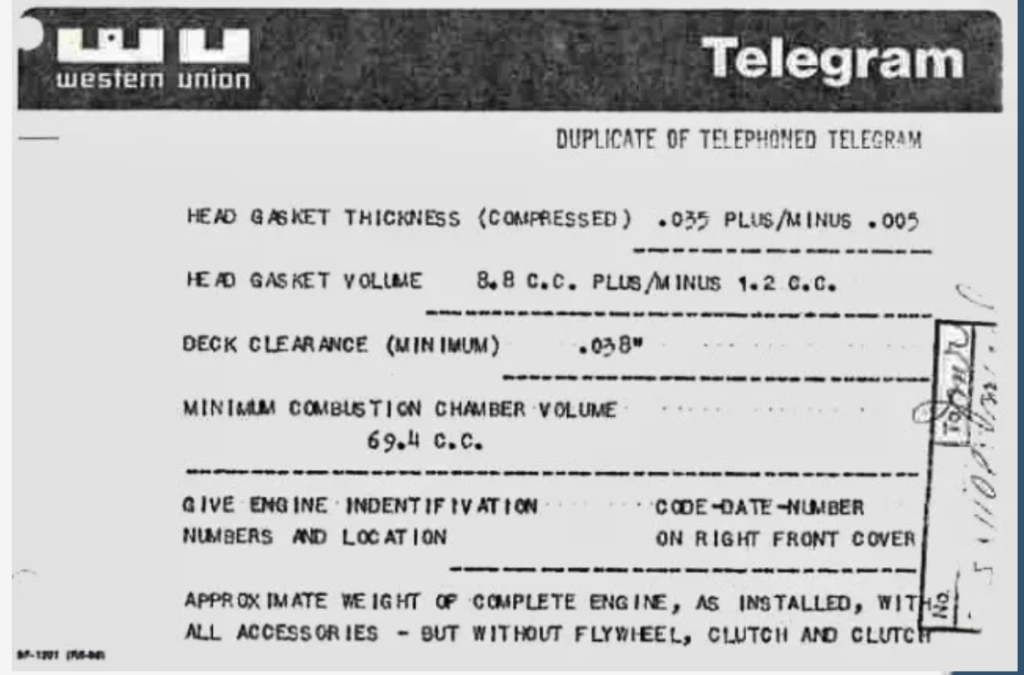
Note-the info in some of the telegrams was first called to the owners via telephone, as shown in the telegram “Duplicate of telephoned telegram”.
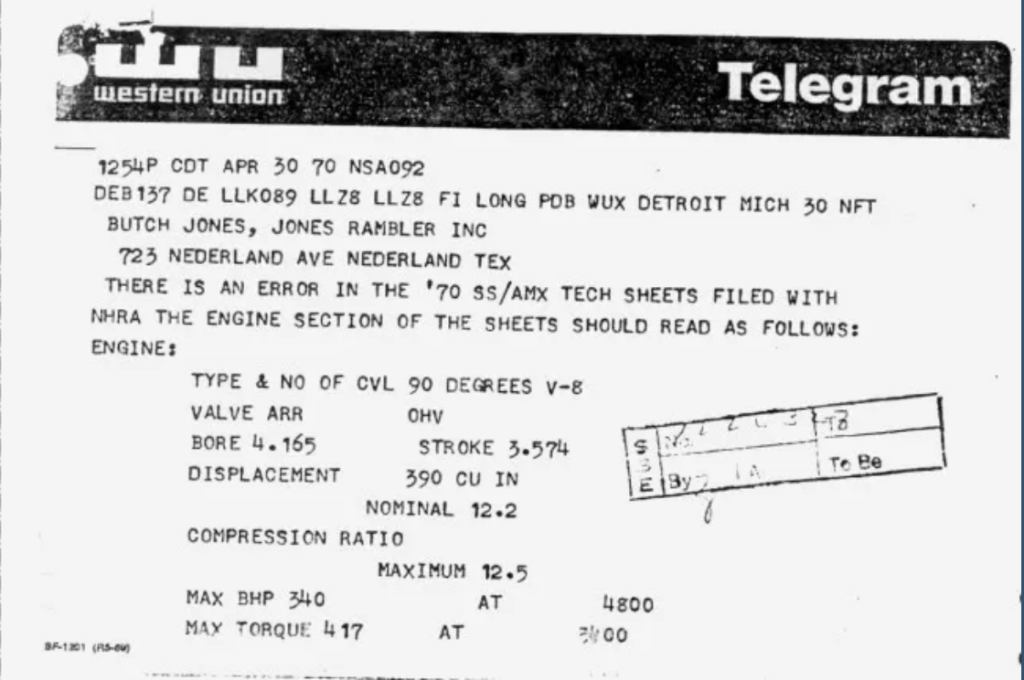
This one seems to address the 70 SS/AMX Tech Sheets (2 pages) (sent to Jones Rambler, Texas. Hurst SS/AMX car #40):
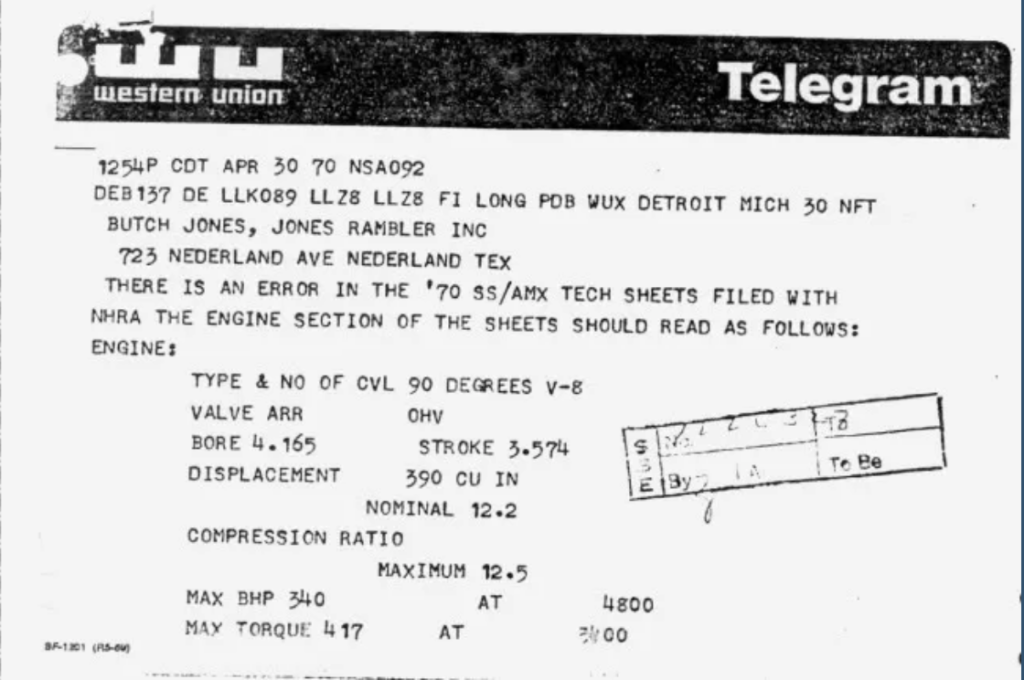
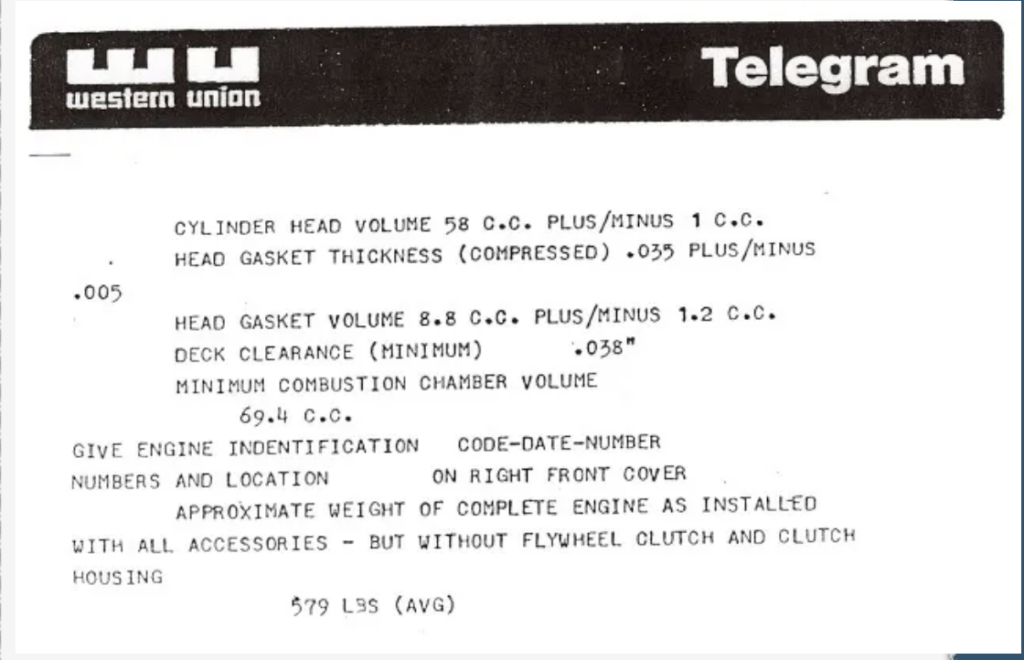
Here is the same telegram, sent to Delrose Motors, Pittsburg, PA. Hurst SS/AMX Car #30:

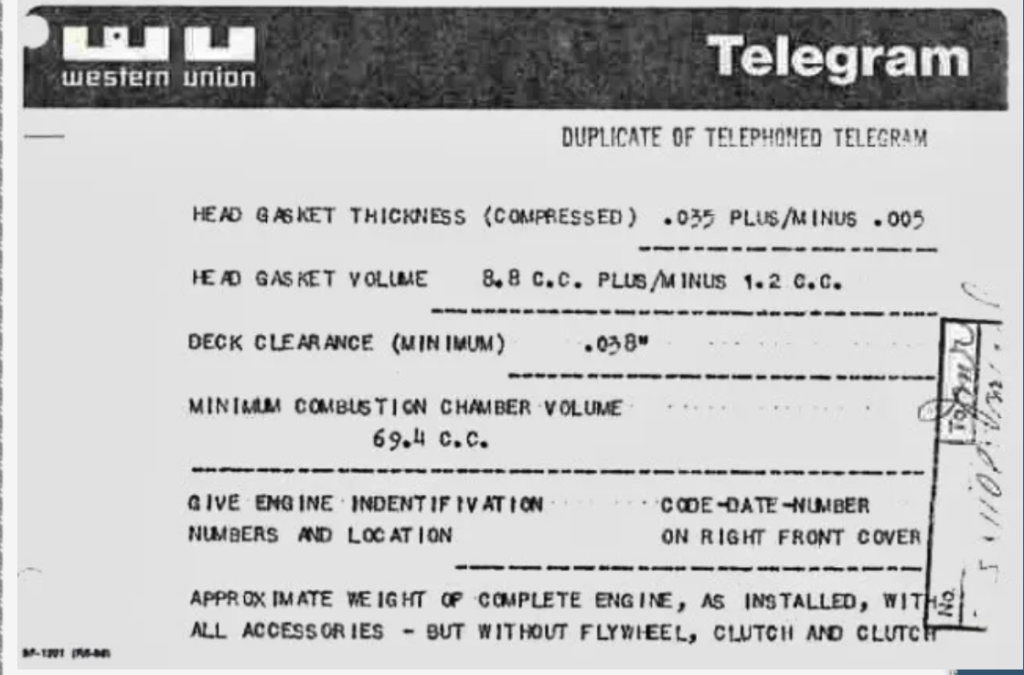
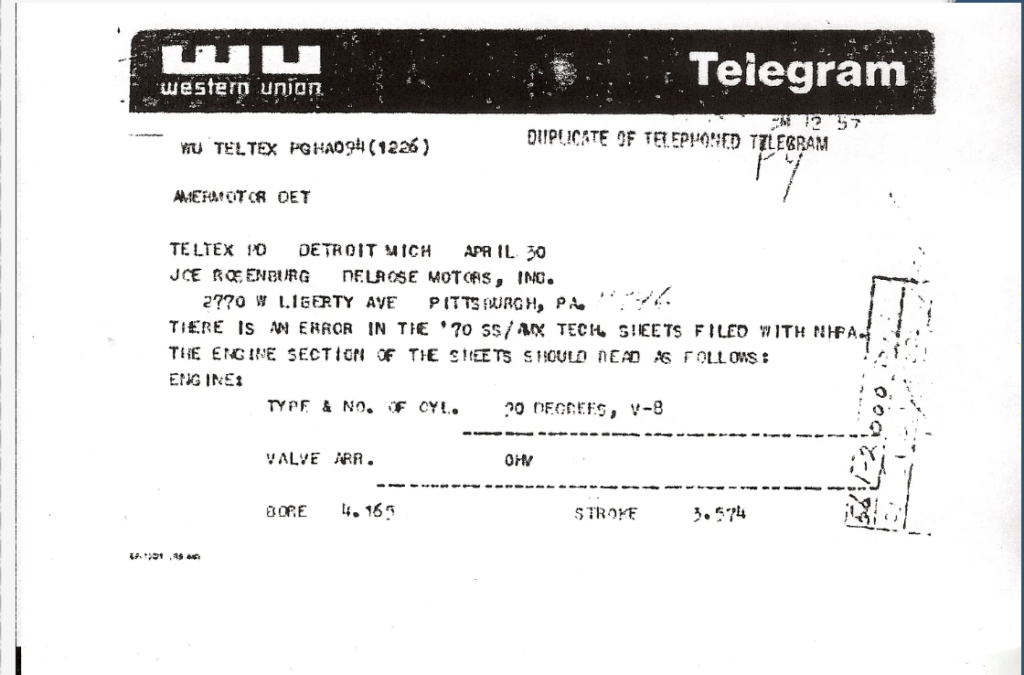

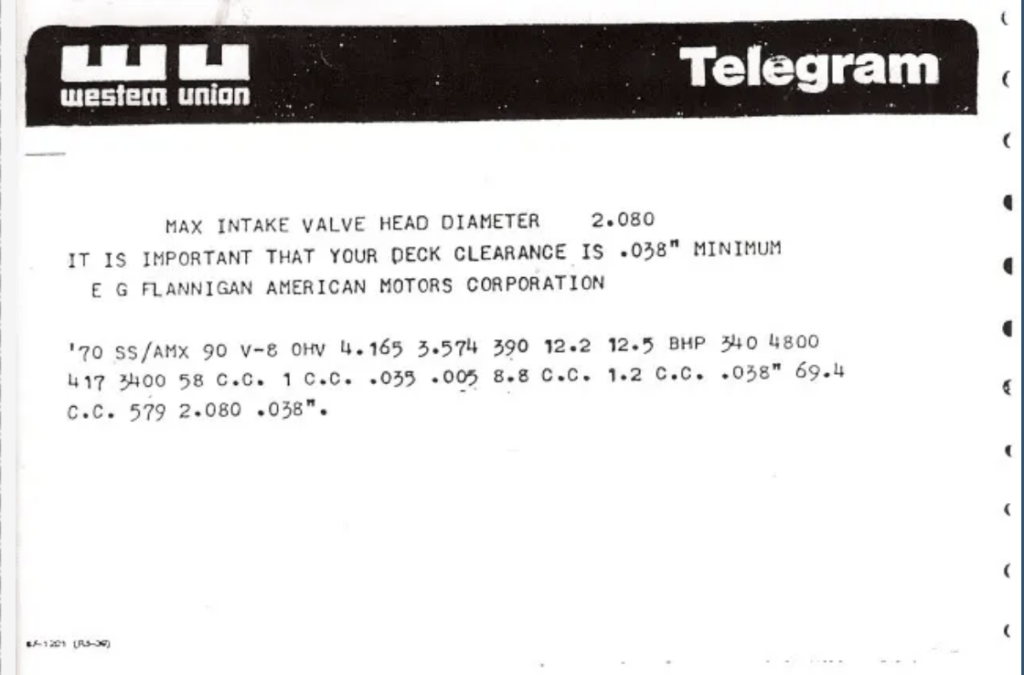
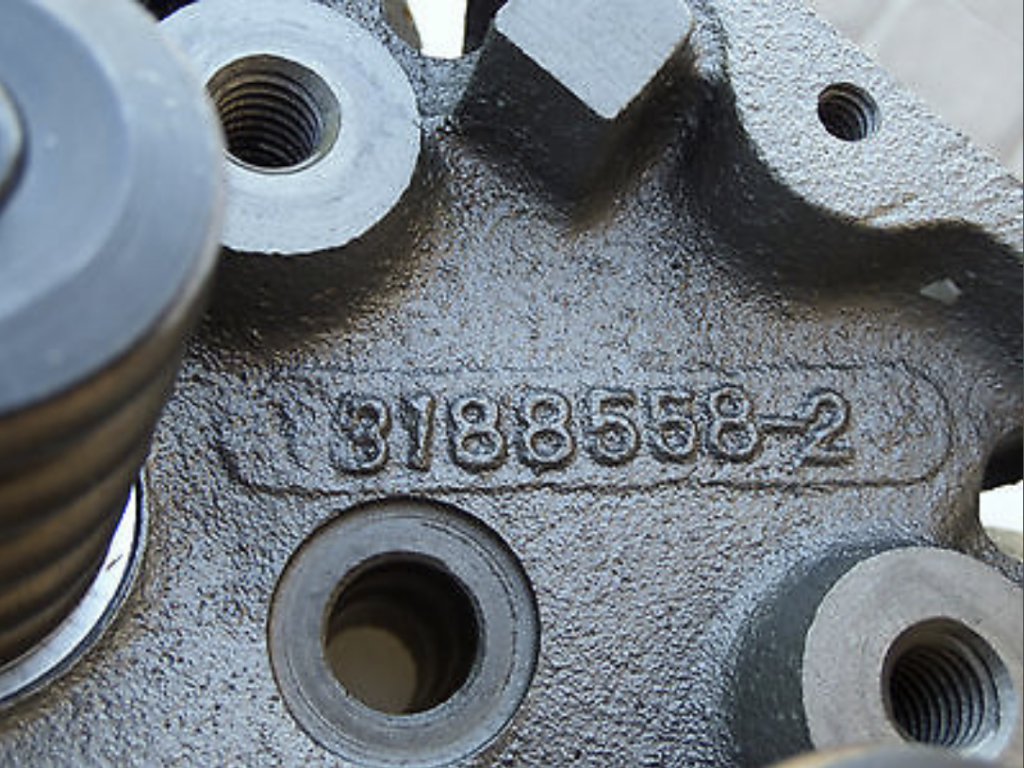
Maybe someone with some serious racing experience could explain what was done to these heads and make a comparison to the 70 dog-leg head and modern technology. Here are some pictures of the heads and the work done (Note the Crane stamp):

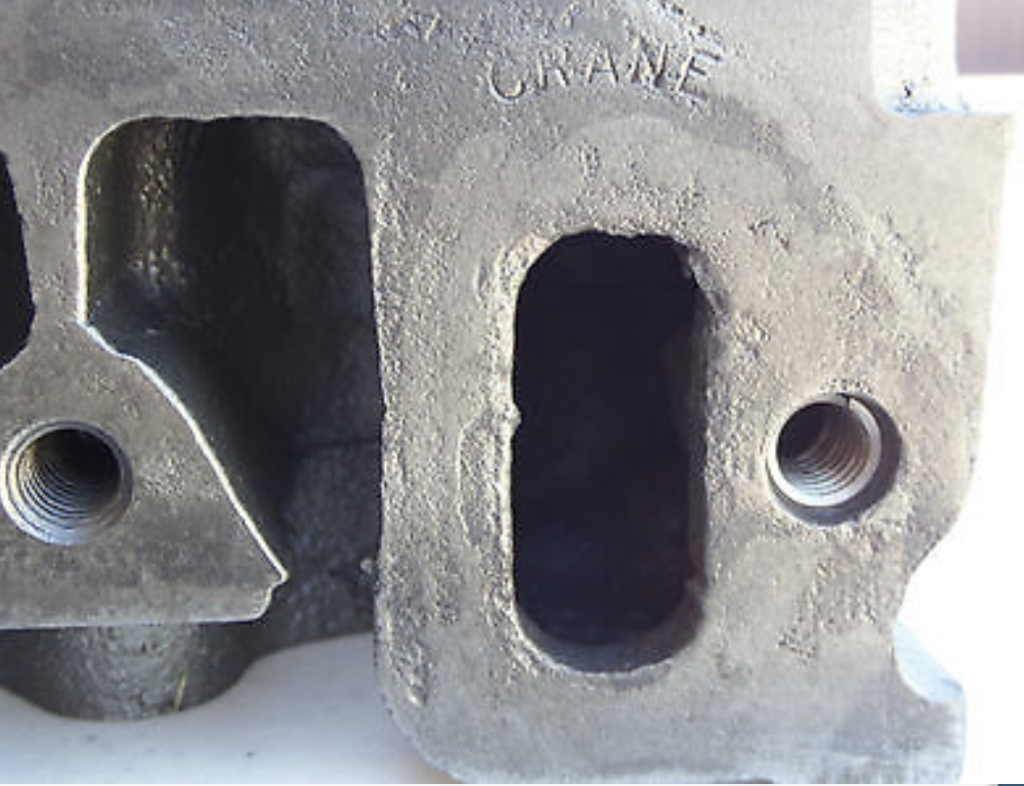
Next, let’s look at some specs on the car. Besides the added feature already mentioned, there were some things deleted. The hood hinges, grill support and hood latch (four hood pins held the hood in place, but were very unpopular and most put hinges back on). The front sway bar, (because the car does not take corners), one horn, and the heater assembly. Sound deadener was also removed (This was the carpet padding, not the deadener sprayed on the inner door skins, quarter panels, etc.). So how was this done? The cars were sent to Hurst as complete running AMXs. Hurst removed the sway bar, horn, intake and carb assembly, exhaust, the various brackets, etc. And the heater? It was often thought Hurst removed it. There are two cars that had the dashes swapped as they match each other’s frame rail. How else could that happen?
Not too long ago there was a discussion as to why Hurst would remove it, why wouldn’t they just not be installed at AMC? As it turns out, the invoice gives a credit for the heater assembly, thus confirming the heaters were not installed on the assembly line. But this once again emphasizes how the AMC community (and me too, here) repeat what they hear as if it is fact. They supposedly came without rocker moldings, mirrors, or wipers. Let’s look at some photos coming right from AMC:
Here is a picture of the new manifold. Note the top isn’t bolted to the bottom yet:

How about this one (Prototype car)? Notice no hood hinges, but especially no paint where they were. (The hinges were there when the car was painted, so paint could not get behind them. This would be correct on all cars). Note the wipers-why, electric! (This is the Prototype car. They were all vacuum in the production version of these Super Stock cars). And the clips for the washer bag are still in place as well. All the washer parts are missing. The grill support is missing as is the filler in front of the radiator. No heater (the cable going into the firewall where the hoses would normally go is a tach-drive. The car was also originally white. One more note on the wipers-the car came with a stock fuel pump, so in this case would not have the top vacuum part.
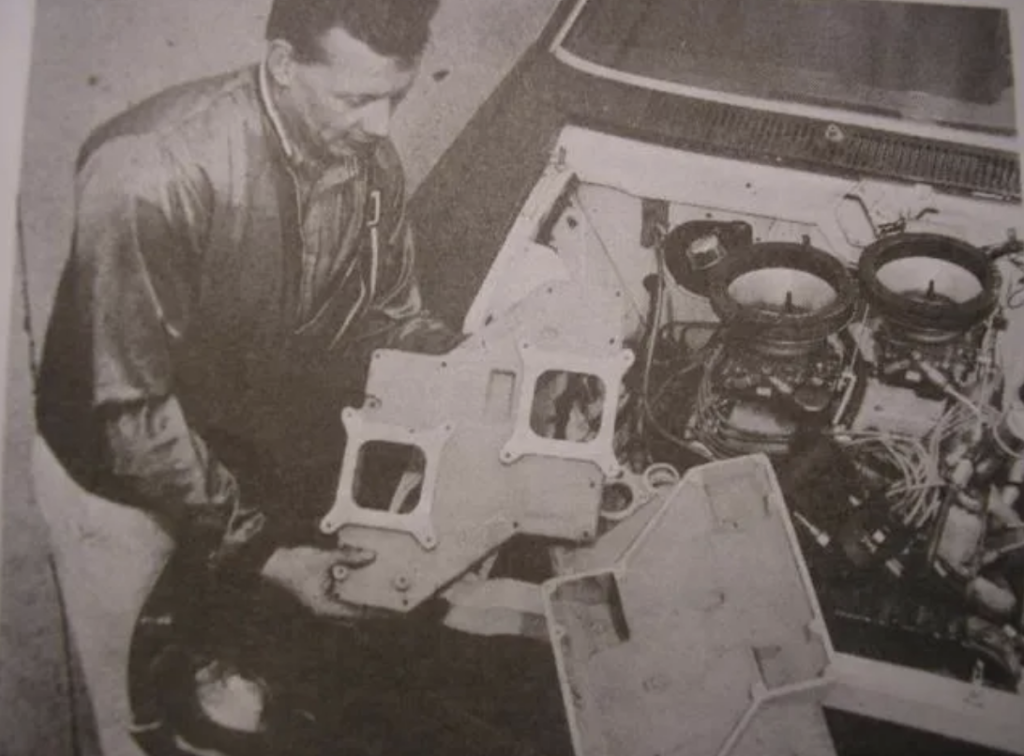
Bundy (Hurst SS/AMX Car #11)-Rocker moldings, no mirror. The cars came with the manual mirror, but they were often removed and the holes were filled:

Pete’s Patriot (Hurst SS/AMX Car #39)-with rocker moldings and manual mirror:

AMX-1 (Hurst SS/AMX Car #31) with rockers (and front plate!):


S & K Speed (Hurst SS/AMX Car #19)-no rockers, manual mirror, note exhaust:

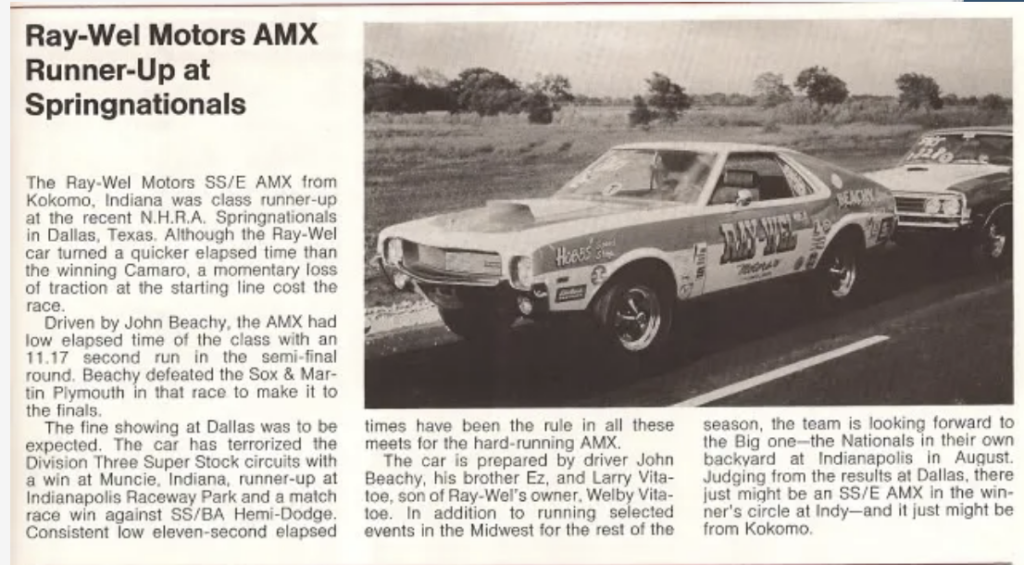
Ray-Wel (Car #unknown)-Rockers, manual mirror, hooded dash:
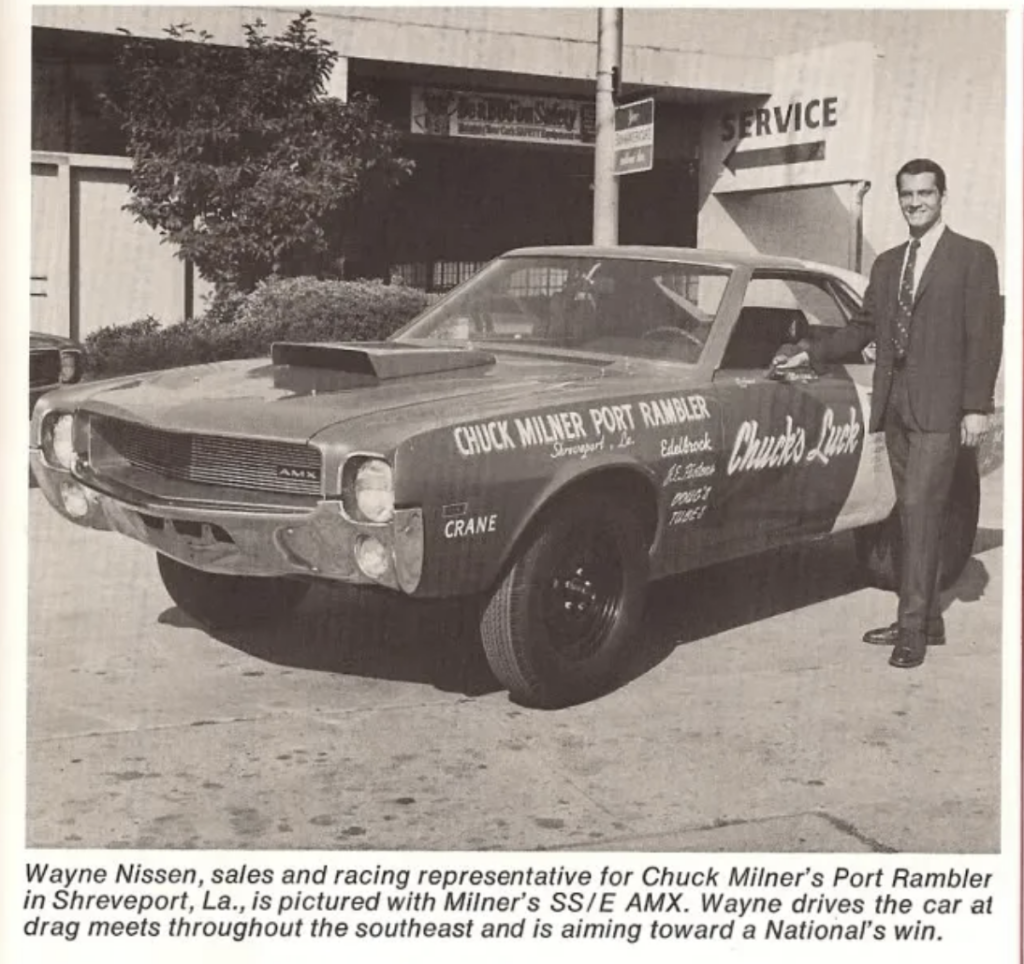
Chuck’s Luck (Car # unknown-missing car)-hooded dash, no rockers, manual mirror-and you can see the front tires were not raised white letter or redline.:
Stowe Engineering (Car # unknown-missing car):
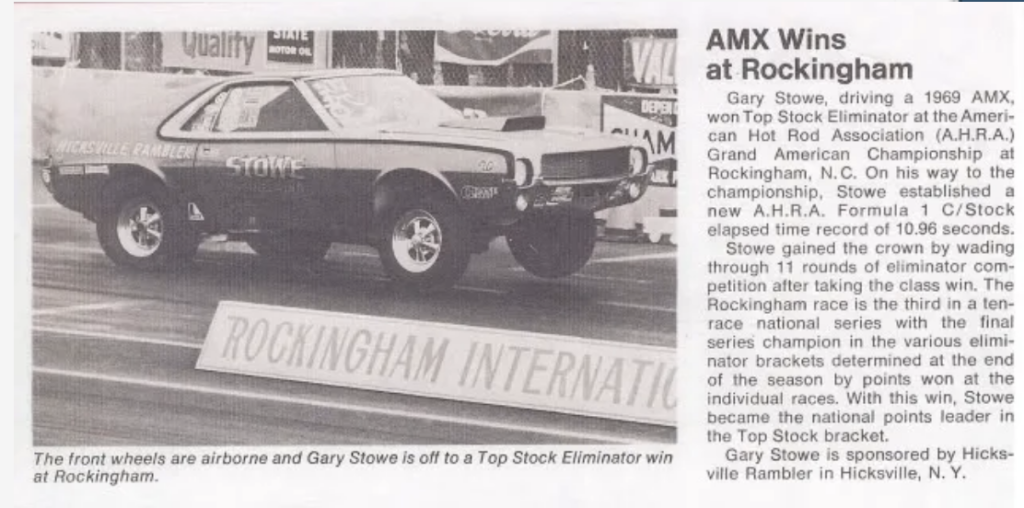
Rodekopf (Hurst SS/AMX Car #50)-one piece crossmember, manual mirror, no rockers:
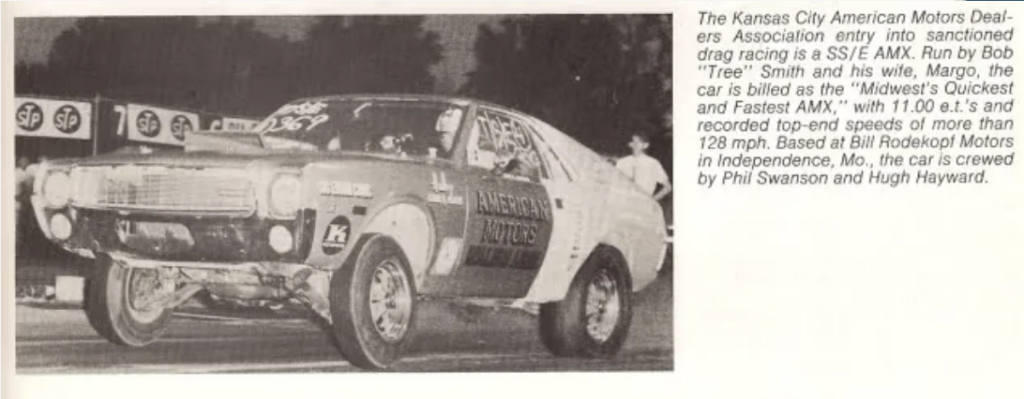
You just have to love this picture:
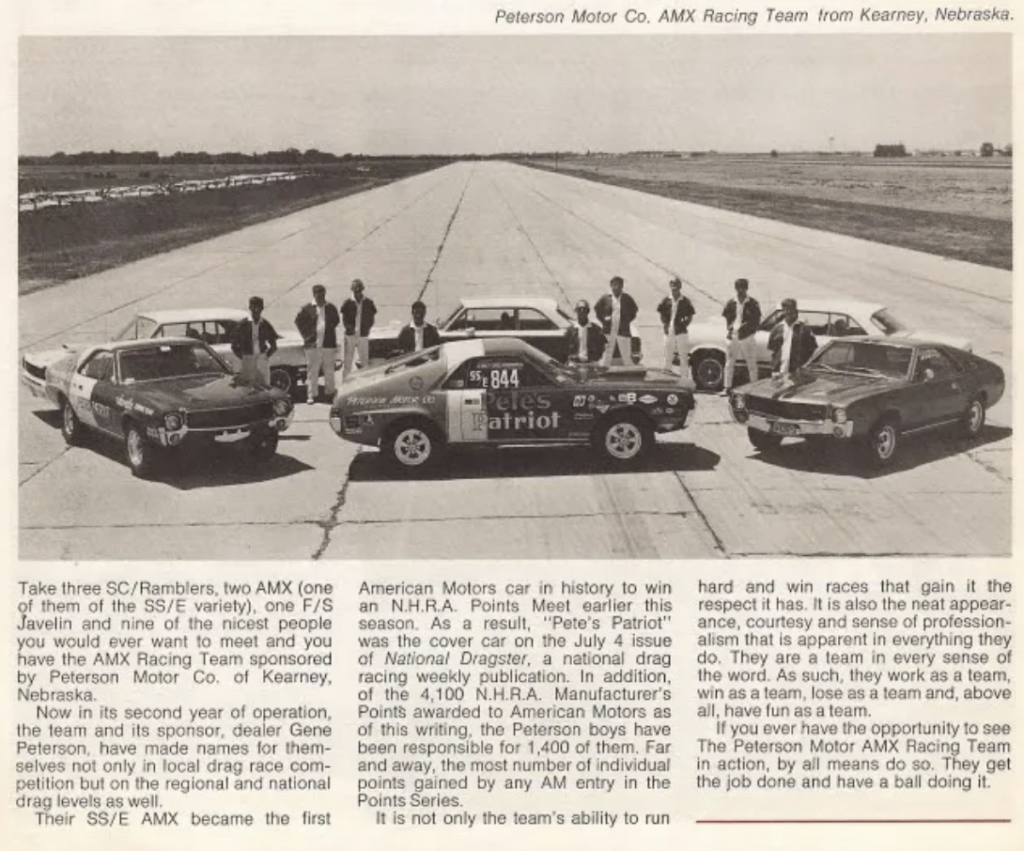
Speculation is the rocker panel moldings were removed due to increasing the wheelwell opening for tire clearance. The rocker moldings just fit on stock cars, so would have to be trimmed-or removed-on a modified car.
Note the picture of Shahan is not the same series as the other pictures as she is wearing a different outfit. Also, note the earlier pictures of the prototype show hinges on the hood, the other picture did not. There are a couple of cars that now have electric wipers, but look at the article of the S & K car-clearly vacuum wipers. (This is how they all came when new).
You might also be interested in the sticker that is on the driver’s door jamb. (The door jamb has been repainted in this picture.
There is paint on the decal, and the screw should not have any paint on it):
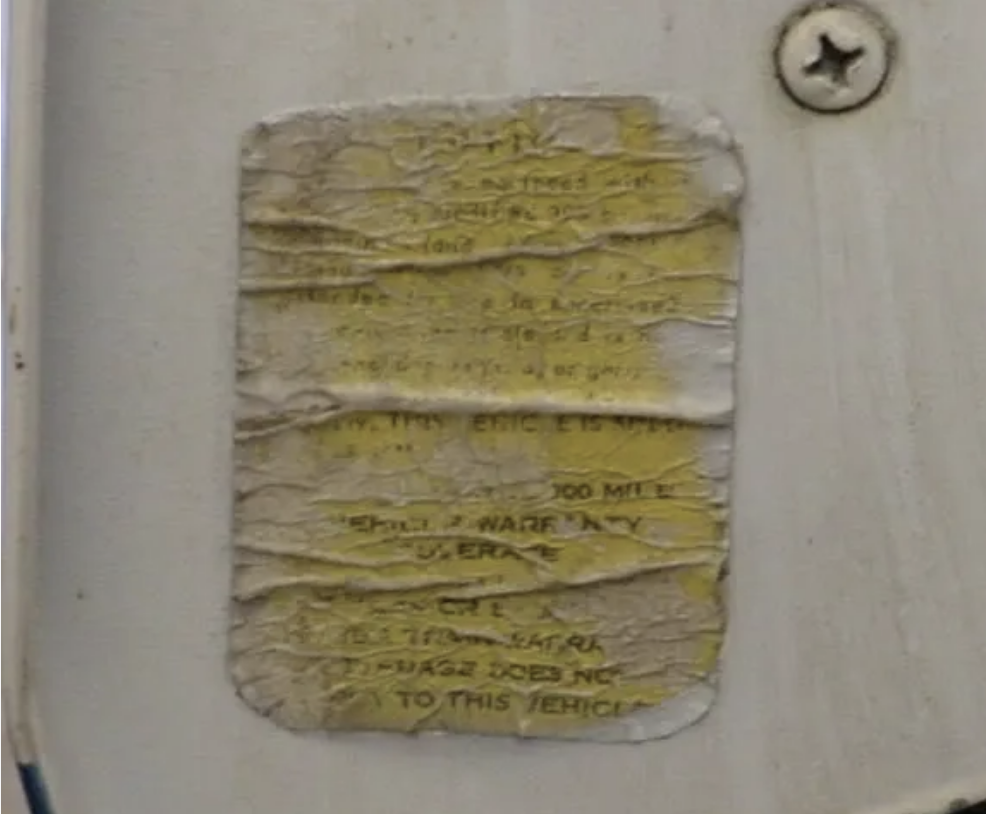
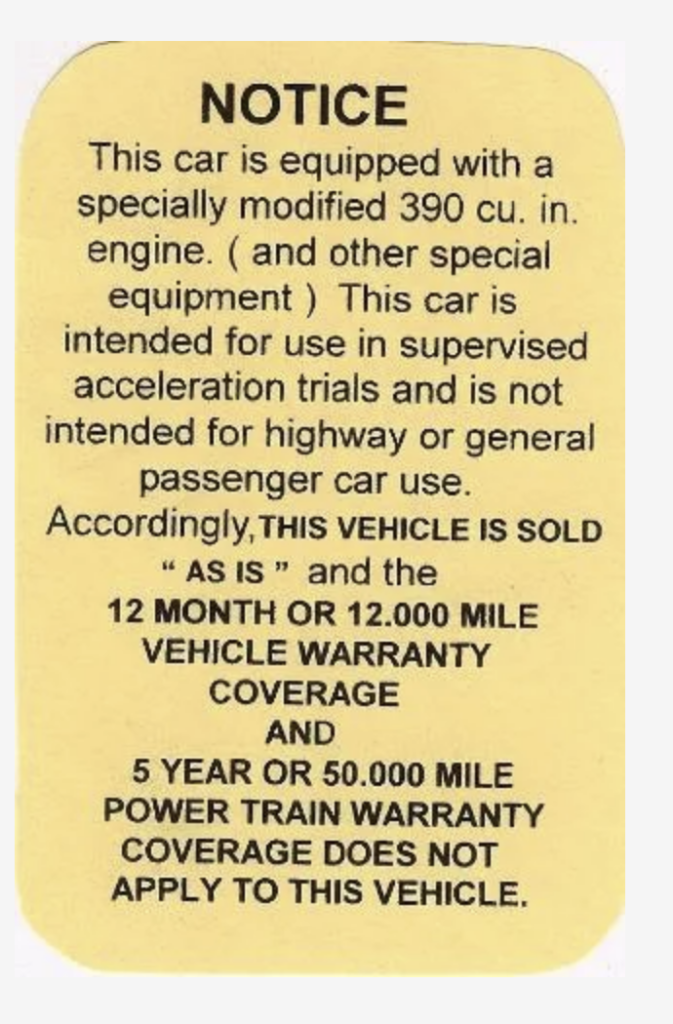
Here is a reproduced sticker (Not exact, just to show the information):
And for reference, here is the tag from the Hemi Dart:

Before I go on, I want to share a notice Dodge used when they sold the Hemi Dart:
The introduction of the S/S Hemi Barracudas created controversy in the stock ranks, where the little guy now found himself pitted against nation record holders in factory-built race cars. On February 20, 1968, Chrysler-Plymouth general sales manager R.D. McLaughlin outlined for dealers- and racers -what they could order. The following is a reprint of his letter in its entirety.
CHRYSLER ANNOUNCEMENT LETTER
1968 SUPER STOCK BARRACUDA
February 20, 1968
TO: All Plymouth Dealers
Subject: 1968 Hemi Barracuda Super Stock
The Chrysler-Plymouth Division offers for the 1968 models a 426 Hemi-Powered Barracuda Fastback for use in supervised acceleration trials. These cars will weigh approximately 3,000 pounds and have been designed to meet the 1968 specifications of the major sanctioning drag strip organizations.
The Hemi-Powered Barracudas will be available through production is
limited quantities in March. To order this vehicle, use the Barracuda
Order Form and specify Body Code BO29 and Transmission Code,
either 4 Speed Manual, Code 393, or Automatic, Code 395. No other
specifications are necessary.
Description of Components
426 cu. In. 8-cylinder engine with dual 4-barrel carburetors-
12.5 to 1compression ratio.
Cross Ram Intake manifold.
1 11/16″ x 1 11/16″ Holley carburetors.
Competition Hooker headers, exhaust pipes, and mufflers
High capacity oil pump.
Roller timing chain (reduced timing chain stretch for more
consistent engine performance).
Mechanical valve gear.
Dual breaker distributor.
Transistor ignition.
Metal core type ignition wires.
Unsilenced air cleaners.
Deep groove fan drive pulleys.
Heavy duty radiator.
Aluminum seven-blade fan equipped with Viscous drive.
Special offset 15″ rear wheels.
Chrysler-built 8 ¾” large stem pinion gear set, and heavy-
duty axle shafts with automatic transmission
(4.86 axle ratio).
Dana-built 9 ¾” heavy-duty axle with manual transmission
(4.88 axle ration).
Sure-Grip differential.
135 Amp. Hr. battery (located in rear compartment).
Heavy-duty high control rear suspension.
Front disc brakes 41/2″ Bolt Circle.
Fiberglass front fenders.
Fiberglass hood with scoop.
Light weight steel doors.
Light weight front bumper.
Light weight side window glass.
High capacity fuel lines.
Business coupe interior (2 bucket seats – no rear seat).
For Manual Transmission Only
Special heavy-duty 10 ½” clutch and flywheel
Safety steel clutch housing.
Competition “Slick Shift” 4-speed transmission.
Hurst remote mounted floor-shift unit with reverse lockout.
For Automatic Transmission Only
High stall speed torque converter (large drive lugs and 7/16″
diameter attaching screws).
Heavy-duty manual shift TorqueFlite transmission.
Hurst floor-mounted shift unit.
Please Note:
The following items are deleted on this body type:
Heater, Body Sealer and Sound Deadeners, Silence Pads, Outside
Mirrors, Right Side Seat Belt and Body ColorPaint.
NO OPTIONAL EQUIPMENT OF ANY KIND CAN BE ORDERED
The policy of Chrysler Corporation is one of continual improvement in design and manufacture, wherever possible, to insure a still finer car. Hence, specifications, equipment and prices are subject to change
without notice.
These vehicles are intended to use in supervised acceleration trials and
other competitive events, therefore, they will be sold without warrant.
Special stickers will be provided for plant installation (attached to left
“A” post) which will read as follows: “This vehicle was not
manufactured for use on public streets, roads or highways and does
not conform to Motor Vehicle Safety Standards.
All customer orders must be accompanied by a signed disclaimer
(sample attached) indicating that the purchaser understands that this
vehicle is sold without warranty and does not conform to Federal
Vehicle Safety Standards.
Any prospective customer who desires to purchase one of these
maximum performance vehicles should be made aware of the following characteristics which make them unsuitable for general use.
A high idle speed is required to insure adequate lubrication,
minimize roughness, and to keep theengine from stalling
The modified intake manifold causes a rich surging condition,
misfiring and unstable engineoperation in cold weather, which makes
ordinary street driving extremely difficult and it is notrecommended
for this use.
Higher than normal oil consumption will be encountered because of increased lubrication to thevalve train and cylinder walls.
The carburetors are calibrated for maximum power and a high
numerical axle ration is used foracceleration. As a result, the gas
mileage is considerably less than for a conventional car.
Engine noise would be objectionable due to increased piston
clearance and mechanical valvetappet clearance.
The ignition system is designed for optimum engine output and
must be kept in top condition. Thismakes it necessary to inspect,
adjust and replace the spark plugs and ignition points morefrequently than would be necessary on a standard engine.
On car equipped with automatic transmission, band adjustment must be made frequently.
Due to performance characteristics, maintenance and operating
expense will be high since premiumfuel is required and frequent oil
changes are a MUST.
Does not conform to Motor Vehicle Safety Standards.
Warranty and Policy Coverage
Any customer purchasing this model vehicle should be advised that
due to the expected use, the vehicle is sold “as is” and the 24 month or
24,000 mile vehicle warranty coverage, the 5 year or 50,000 mile Power
Train Warranty coverage, or any other warranty coverage (including,
but not limited to the implied warranties of fitness for purpose intended or merchantability) will not apply to the vehicle. The manufacturer assumes no responsibility for the manner in which such vehicles operate.
Any repairs or adjustments which you believe warranty factory
participation should be brought to the attention of your Regional
Service Office where such requests will be handled on individual merits.
Attached is a form letter (to be prepared on your letterhead) which
should be thoroughly understood and signedby each prospective
purchaser and attached to your order for each Hemi Barracuda Super
Stock. The purpose ofthe letter is to explain the normal operation
characteristics of these vehicles and clarify that the warrantycoverage’s do not apply. Be sure a letter in this form, signed by your customer, is included with your order sothere will be no delay.
1968 Hemi Barracuda
It was inevitable that Chrysler would build the Hemi Barracuda. For
the past four years, drag racers had beengutting Barracudas and
dropping in 392 and 426 Elephant Engines. Since Chrysler had enjoyed tremendoussuccess on the dragstrips in Super Stock and Unlimited
Fuel since 1963, the decision to continue that dominationby building a factory super stocker (with some assistance from Hurst) was a natural.
The S/S Hemi Barracuda was assembled by Chrysler as a package and
then shipped to Hurst. Although thenumber varies from source to
source, at least fifty and possibly as many as seventy-five Barracudas
were shippedto Hurst’s facility in Detroit. The conversions were
coordinated by Dick Maxwell at Chrysler and Richard Chryslerat
Hurst. As delivered to the dealers, the cars had fiberglass hoods and
fenders, while the front bumper and doorswere light-gauge steel. The
interiors were gutted and Bostrom driver seats installed.
To squeeze the mighty Elephant into the Barracuda’s tight engine bay,
some modifications had to be made underthe hood. The battery was
moved to the trunk, and the right shock tower was moved, as was the
master cylinder.Hurst also installed custom headers, shift linkages for
four-speed cars and special rear-axle assemblies. Off thetransport trailer the cars were delivered on street tires. All that was needed to make the car competitive was slicks,a deeper oil pan (a small pan was installed for shipping), camshaft and valvetrain.
The S/S Hemi Barracudas were delivered to racers in early May, in time to qualify for the NHRA Spring Nationals.Ronnie Sox was one of thefirst to get a Hemi Barracuda on the strip and turned mid 10s right out of the box.
Does this look at all familiar? I wonder if the owners of the SS/AMX had to sign some specific paperwork like the owners of the Hemi Dart?
The cars did not use the same shifter as stock, but it was replaced with a shifter that had reverse lock-out, and they did change the rods to a thicker set to prevent bending, and a steel plate replaced the aluminum one that attached the shifter assembly to the tranny. The plate was stronger than the aluminum one, and moved the shifter about 6 inches to have it closer to the driver. Also, a new “T” handle. If you look at some pictures, you will see a stock looking shifter, but also the stock ring and boot, and in the same location. To cut the floor to relocate it would also mean moving carpet, the plastic hump, etc. The carpets were cut and then sewn back together to accommodate the shifter I will wager the heater assembly not being put in the car when it was made on the assembly line. I say this because look at the following document:

As you can see, there is a credit for the heater assembly on the invoice. There is no credit for the hinges, sway bar, etc. and they were also removed from the car-the difference is, they were not removed at the factory, but rather at Hurst. And as was pointed out, there is no mention of the heater assembly removal in the Hurst build paperwork. Here is a great original looking under hood shot:

You can see the two covers on the firewall that replaced the heater assembly. The large round piece is actually a formed piece and it had a foam gasket to seal it. There was a flat piece that covered the holes for the heater core and hoses. Neither one were painted from the factory, but left primer black.
Usually these were painted body color. Some other things to notice is the lack of hood latch assembly, and notice no paint where it would go as it was also on the car when painted. Vacuum wipers and washers, no paint under the removed hood hinges, no fender support bars, or the piece in front of the radiator. Still has the clips for the washer bag. And…what’s with the battery under the hood? This was changed by an owner. It came in the trunk. You can see the hole with the cable going through the firewall just under the heater block-off plate. (Hurst just enlarged an existing hole). Also, note this has a 70 grill. It gives a good shot of the four hood pins, and shows some overspray in various places where the car was painted. Wrong distributor here also. This is the correct brake master cylinder with the bolt-on cap. And a manual mirror.
Still more about the wipers. There is no fitting for the manifold source on the intake, but pictures such as the S & K car and many others clearly show vacuum wipers. When delivered to Hurst the cars had stock manifolds, to include the fitting. They came with vacuum wipers (except the prototype, which clearly had electric). I believe the others with electric wipers were changed by later owners. There are also some pictures that do not show a mirror. I believe they all came with a manual mirror as there was a hole in the door for the remote cable and I doubt Hurst would do the bodywork to cover it up when it would be cheaper and easier to just put a mirror there. Many an owner did do this work to remove the mirror, however I still question the hooded dash. The VIN shows it was ordered around January 11, 1969 and that is close to when the hooded dash came out. But the new hooded dash had chrome inserts, and none of them seem to have those.
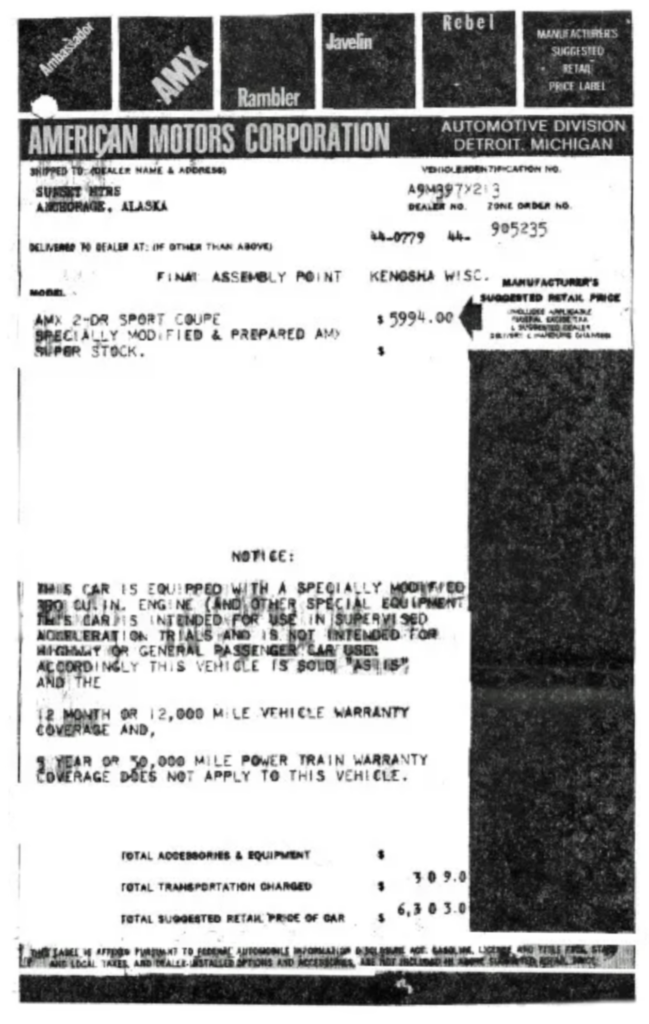
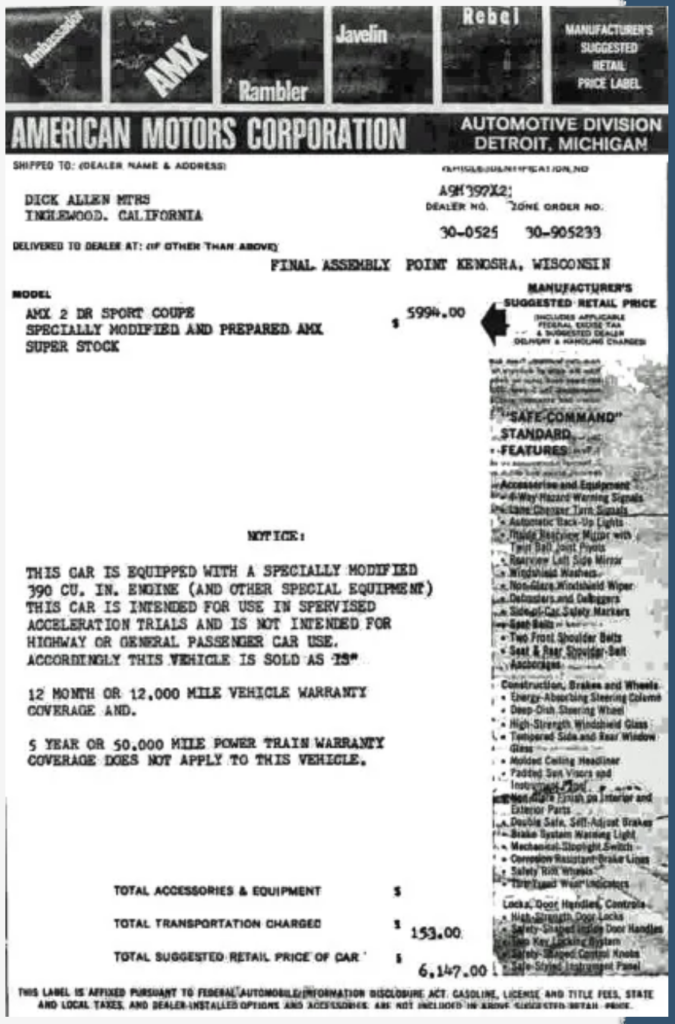
Plus there are some without the hooded part as well. Could it be none had the hooded dash when new, and they were added later? No, because there are some period pictures that show both the hooded and non-hooded dashes. Curious Another piece of documentation: the ssamx.com website offers two original copies of the dealer sticker price. Here they are:
From Hurst SS/AMX Car #52 (on the website):
From Hurst SS/AMX Car #26:
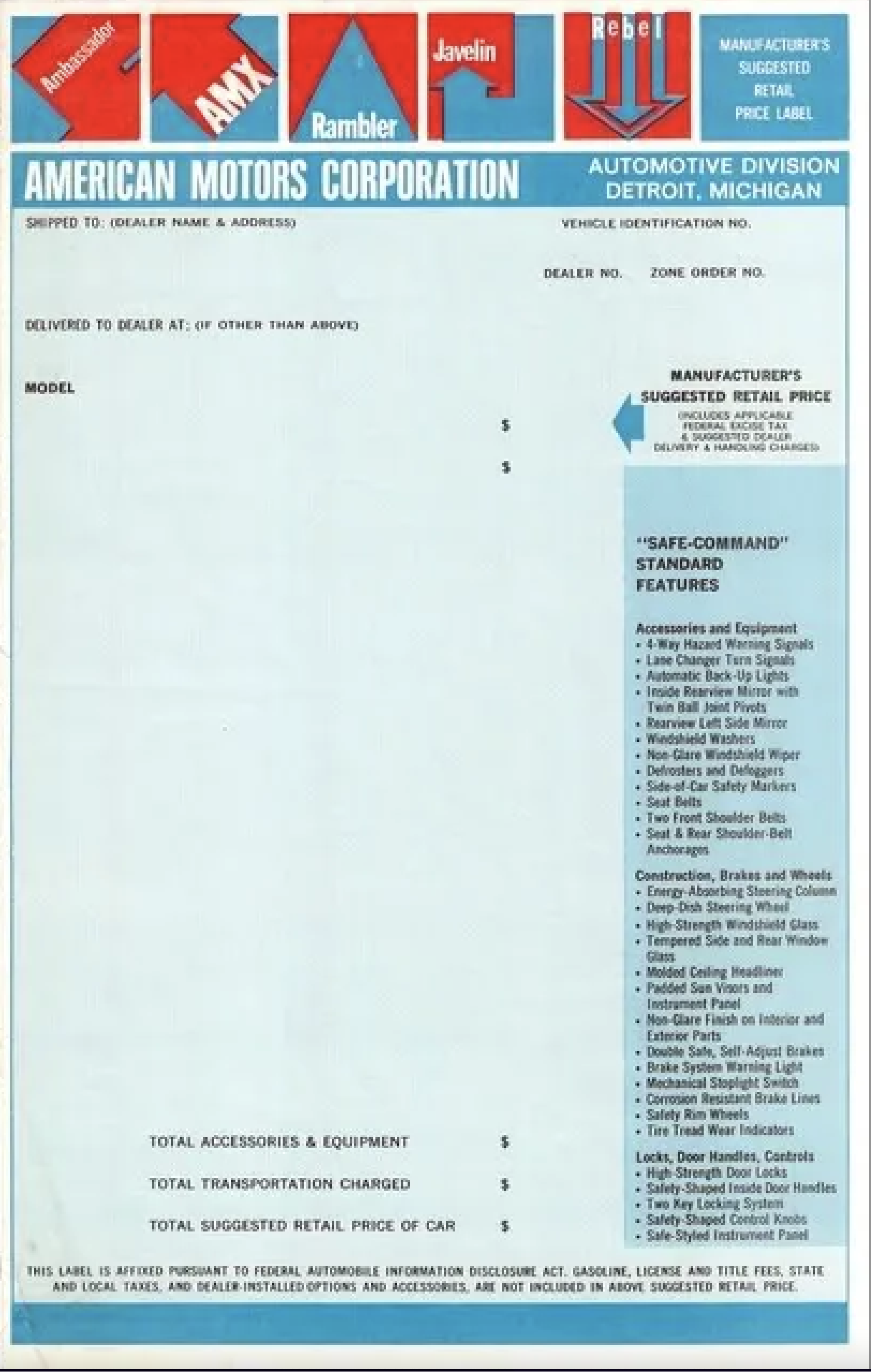
When a car had a price increase AMC would send the dealer blank sticker price labels (Monroney Labels) so the price change could be added. Here is a blank 1969 label:
The price is the same except for the delivery charge. But this is the sticker price, and everyone knows there is room for negotiation. Look back to one of the first documents posted: an agreement stating the car would not exceed $5000. Yet, the sticker shows it did. So the dealer cost is obviously less than sticker, but how much less? $1000 seems like an awful lot. Did AMC sell the cars at a discount to the dealers? I wonder what the final dealer cost was? When the Big Bad color option came out there was a promotion where the dealers got it free, and were still able to pass the cost on to the customers (a whole $34.) And look at these car order numbers-only two apart!
Before I move on, here are two more pieces of original documentation. The first is the Certificate of Origin for Hurst SS/AMX Car #41 (Note the date: 3-8-69):
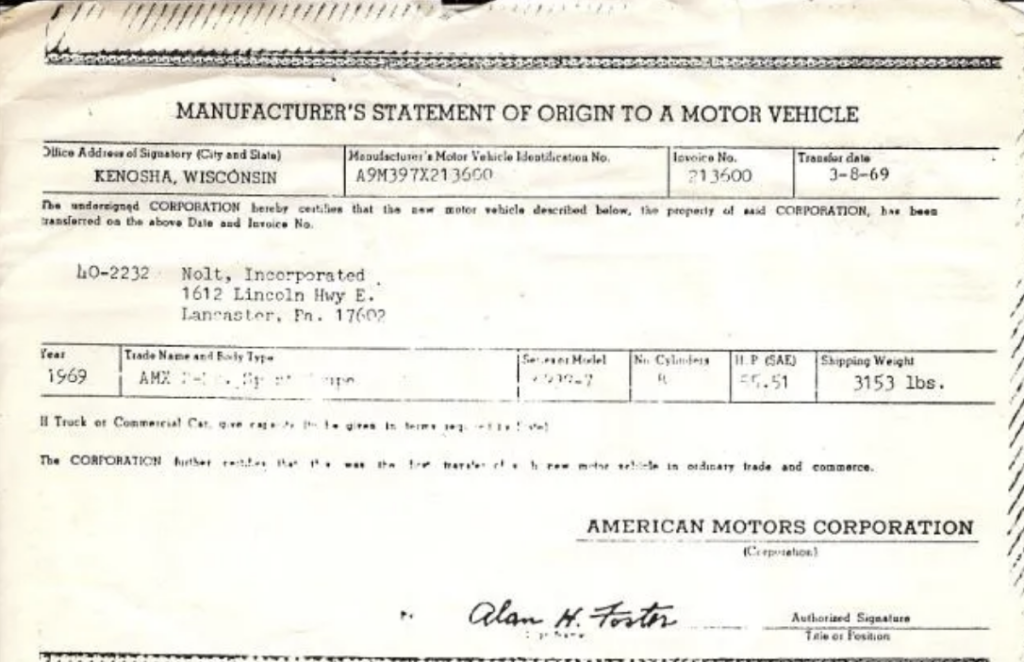
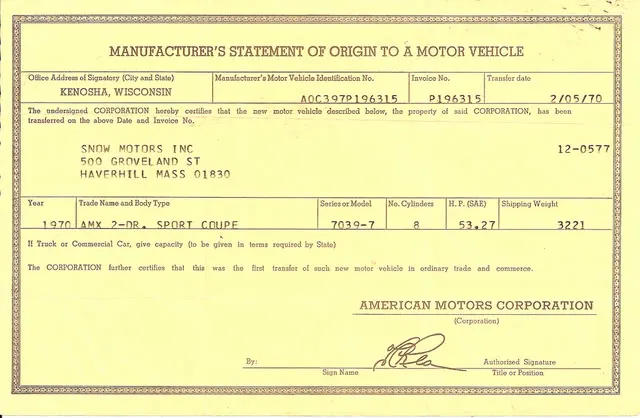
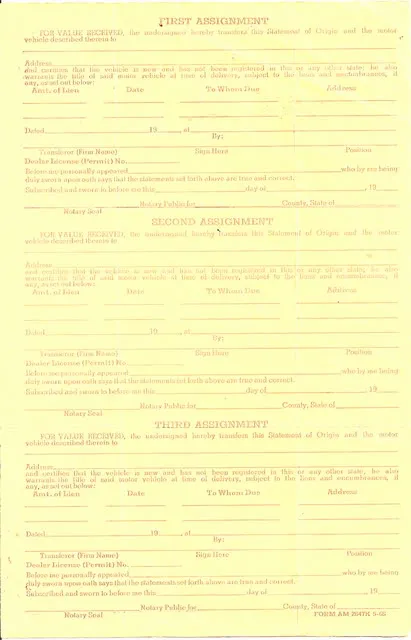
A cleaner copy from a 1970 AMX:
This is the Bill of Laden sheet for Hurst SS/AMX Car #30:
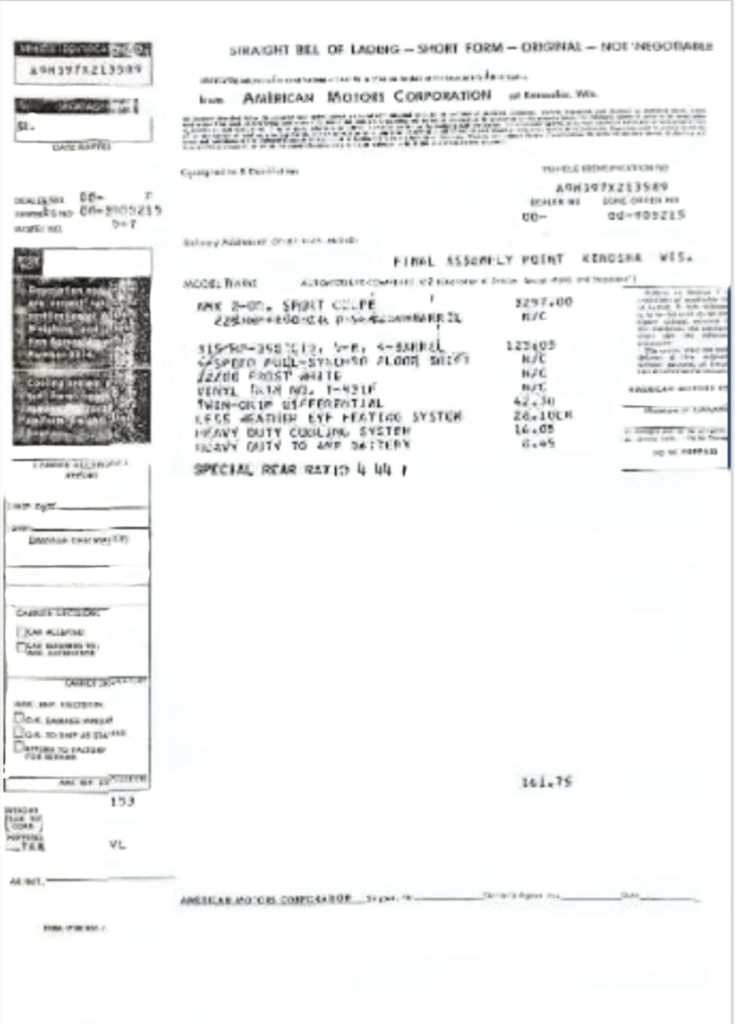
Hereis a cleaned up copy:

Next, I’ll look at the actual cost of the car and components to see if this was such a deal or not.
Yoast SEO
Toggle panel: Yoast SEO
Focus keyphraseHelp on choosing the perfect focus keyphrase(Opens in a new browser tab)
Get related keyphrases(Opens in a new browser tab)
Search appearance
Determine how your post should look in the search results.Preview as:Mobile resultDesktop result
Url preview:

SUPER STOCK AMX .COMstaging.superstockamx.com› 2024 › 03 › 01 › history-4
SEO title preview:
SUPER STOCK AMX .COM – History 4
Meta description preview:
Mar 1, 2024 - Please provide a meta description by editing the snippet below. If you don’t, Google will try to find a relevant part of your post to show in the search results.
SEO titleUse AIInsert variable
Site title Separator Title Primary category
Slug
Meta descriptionUse AIInsert variable
SEO analysisEnter a focus keyphrase to calculate the SEO score
Premium SEO analysisPremiumAdd related keyphrasePremiumTrack SEO performanceInternal linking suggestionsPremium
Cornerstone content
Advanced
Insights
- Post
- Block
Summary
VisibilityPublic
PublishMarch 1, 2024 5:43 am UTC+0
URLstaging.superstockamx.com/2024/03/01/history-4/Stick to the top of the blogAUTHORKeryn VDDtbenvieSwitch to draftMove to trash
Yoast SEO
Readability analysis: Needs improvement
SEO analysis: Needs improvementImprove your post with Yoast SEO
Categories
Tags
ADD NEW TAG
Separate with commas or the Enter key.
Featured image
Set featured image
Excerpt
WRITE AN EXCERPT (OPTIONAL)
Learn more about manual excerpts(opens in a new tab)
Discussion
Allow commentsAllow pingbacks & trackbacksOpen publish panel
- Post