
Now the cars were a go. The cars were built as completed units on the AMC assembly line and shipped to Hurst for the final change to a Super Stock racecar. They were all built
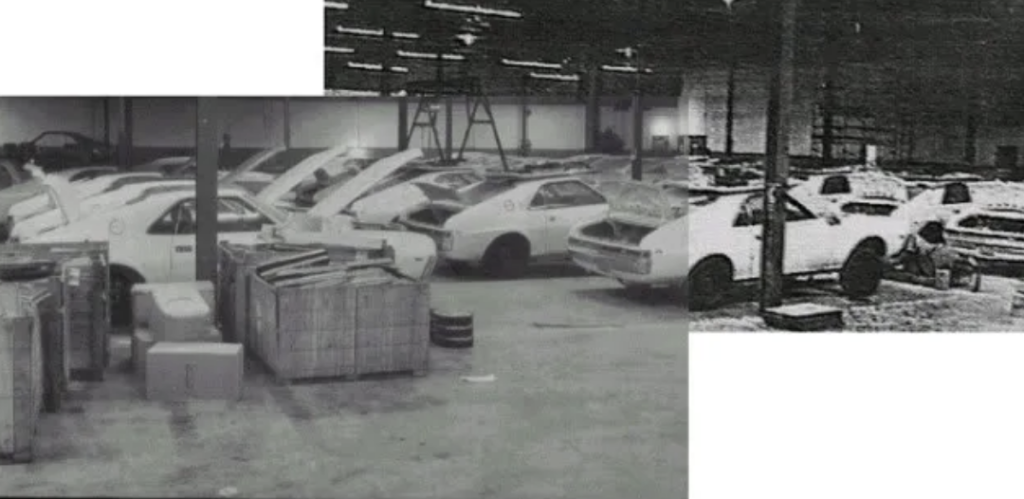
exactly the same. There are two pictures of the cars in the Hurst facility, one from Car Craft, the other from Car Exchange. (Picture has been credited to A. B. Shuman, but he said it was a Hurst publicity shot. I wonder how many they took? Shuman used the pic in an article he did about the Shahans for Car Craft -see article below.)
So let’s look at photo number 1.
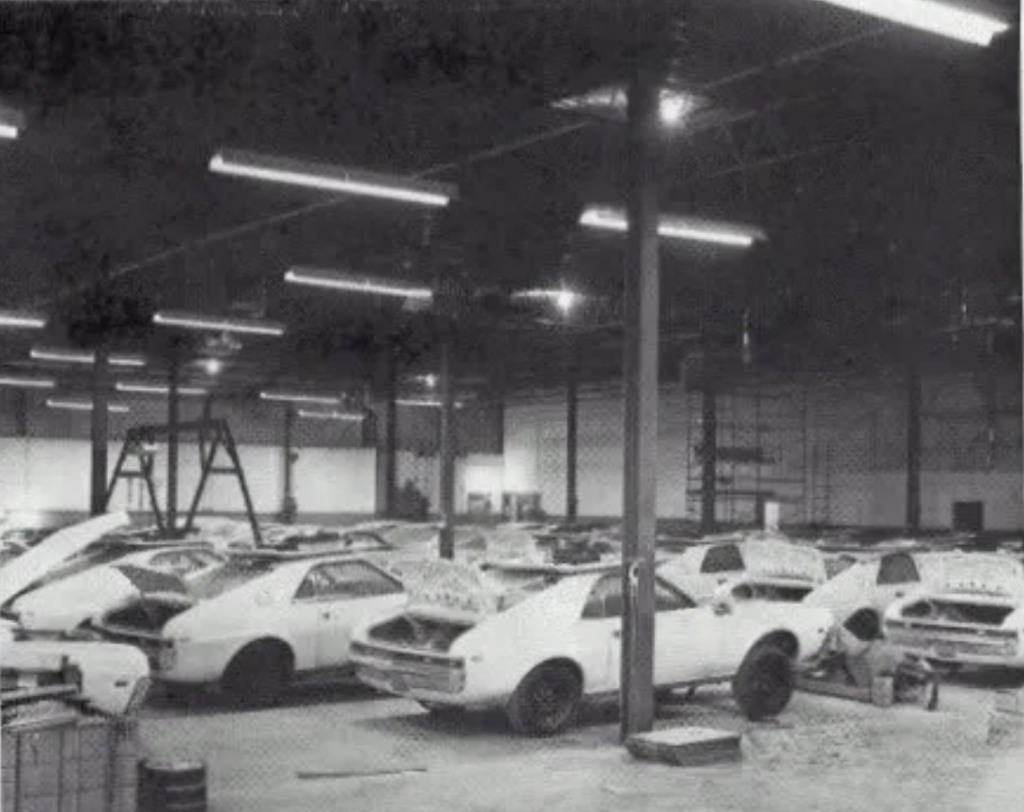
The cars appear white with black wheels. Possibly 3 air cleaner assemblies stacked near the crate. Some hoods appear to be upside down on the roofs, other are still on the car. Decklids are open.
There appears to be an engine/tranny combo on a wooden pallet in front of one car. There is a portable engine puller in front of one of the cars. There is some stuff on top of the upside down hoods. And please note: Rocker Moldings!
Another myth undone.
Now look at photo number 2.
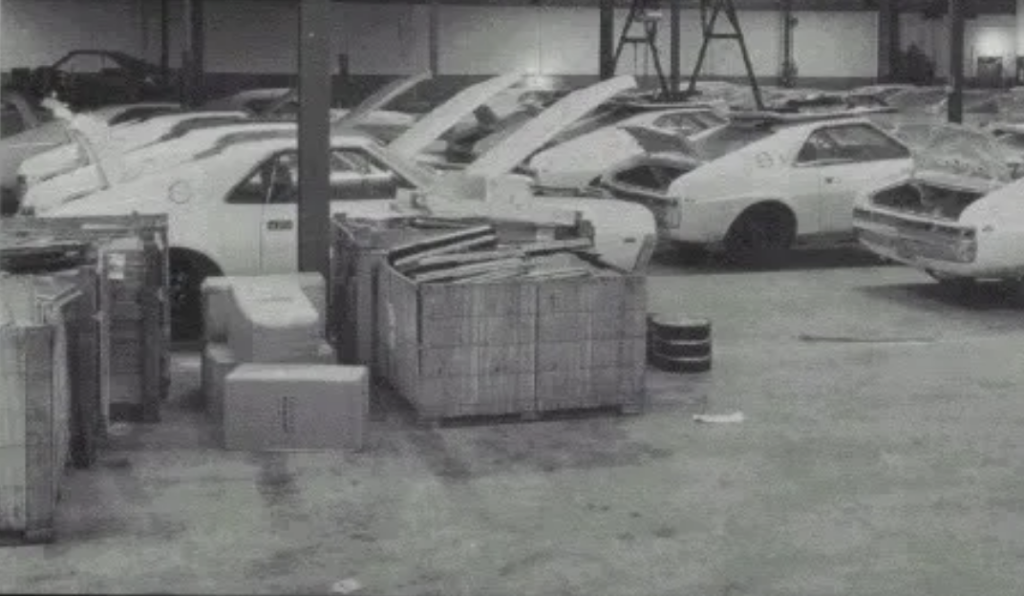
There are obviously some stamped metal parts in the crates. No idea what they had to do with AMC
They are possibly floor pans from the Dodge Taxi project as they were being worked on when some of the AMX owners came to take delivery of their AMXs from the Hurst facility.
The first car looks like it is missing the steering wheel as you look through the passenger door window. And look all the way back at the car up higher than the rest. Sure looks like a Javelin to me, missing the door and nose. So anyone know what that is doing there? A Hurst SS/Javelin? And does it have paperwork, or will it be lost to history because it does not? More later, but this is the Hurst NASCAR Javelin.
Now look at both pictures combined and cropped
Now here is some “hearsay” evidence. This is word of mouth evidence without any documented back-up. I talked to “Doc” Watson in the mid-80s, I think about 1984-85. He told me numerous times AMC was the worst company to do business with as they wanted things “on the cheap”. One thing he told me was a story about the cylinder heads. Hurst wanted 50 sets of heads sent to Crane, modified, and then sent back to Hurst for installation. AMC wanted Hurst to remove the factory heads, send them to Crane, then wait for them to come back.
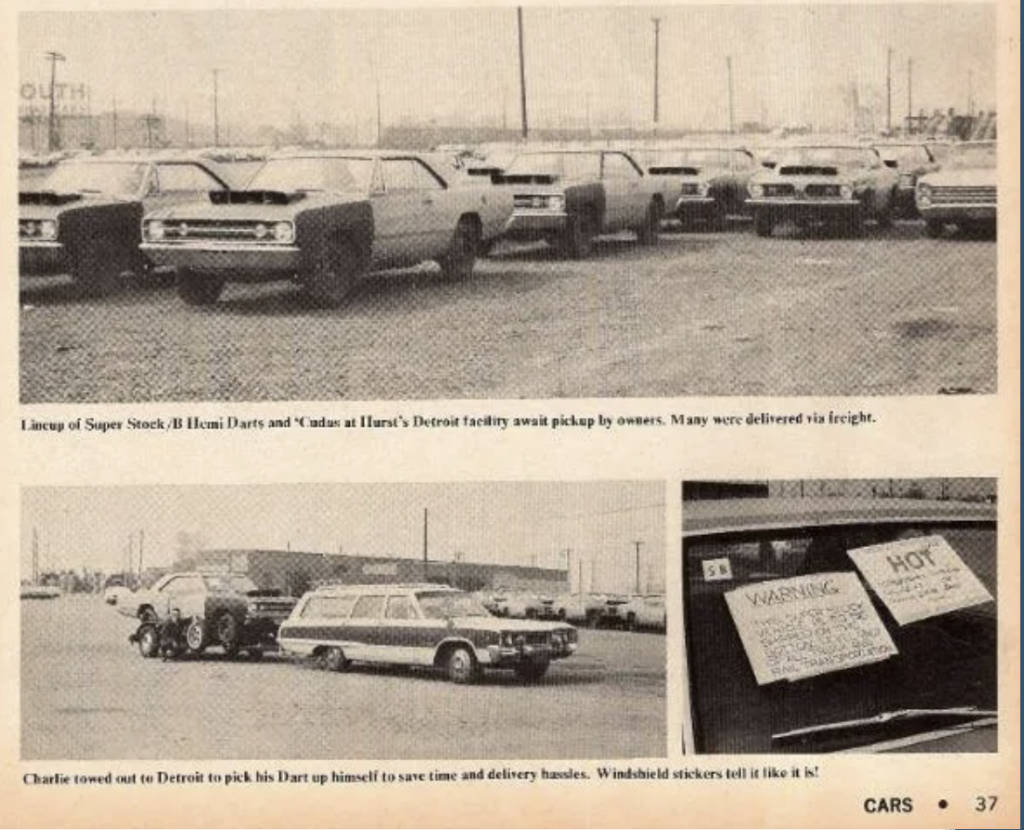
Watson told me arrangements were made to send half the cars to Hurst for the modifications, then when done they would take the other half. AMC sent all the cars at once, which really ticked off the boys at Hurst. He told me he sent half of them back to AMC. So was there room outside the plant to store the vehicles until they were done? And if so, is that a practice Hurst used? There must be some pictures or documents somewhere. This picture does NOT show all the Hurst cars being modified.
Here is a picture of the Hemi Darts outside the Hurst facility.
You can see it may not have held 50 cars (And there is a taxi on the far right):
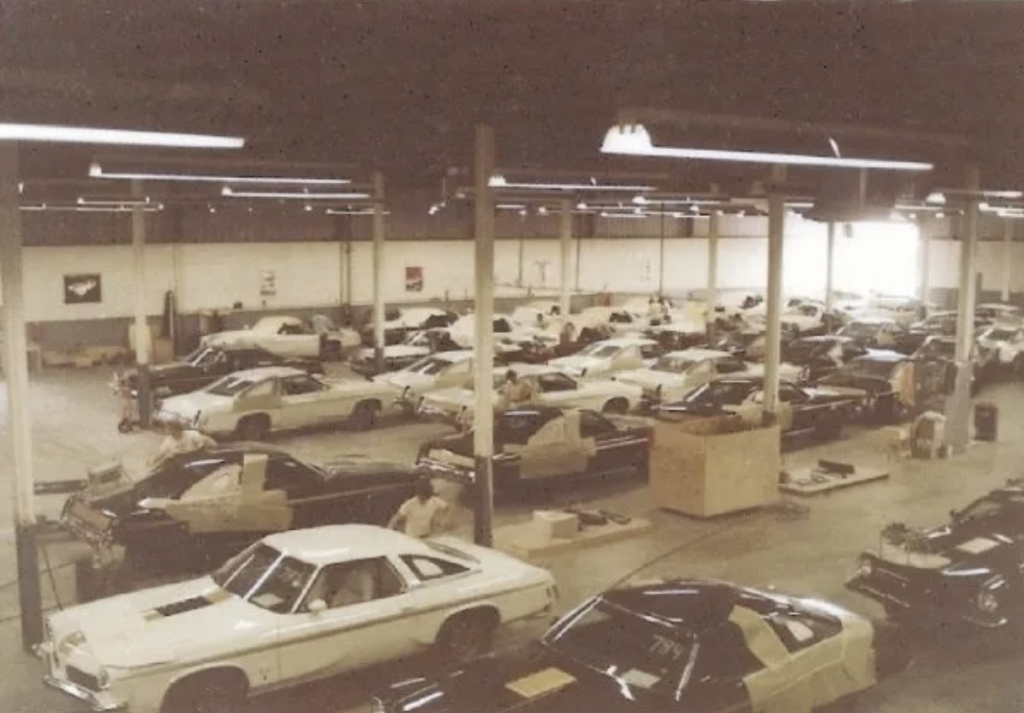
And here is the building a few years later filled with Hurst/Olds:
Another myth down.
And speaking of myths. For the longest time, everyone said the SC/Ramblers were also done at the Hurst facility. Swore to it, some even saw them there. Used this photo to document it:
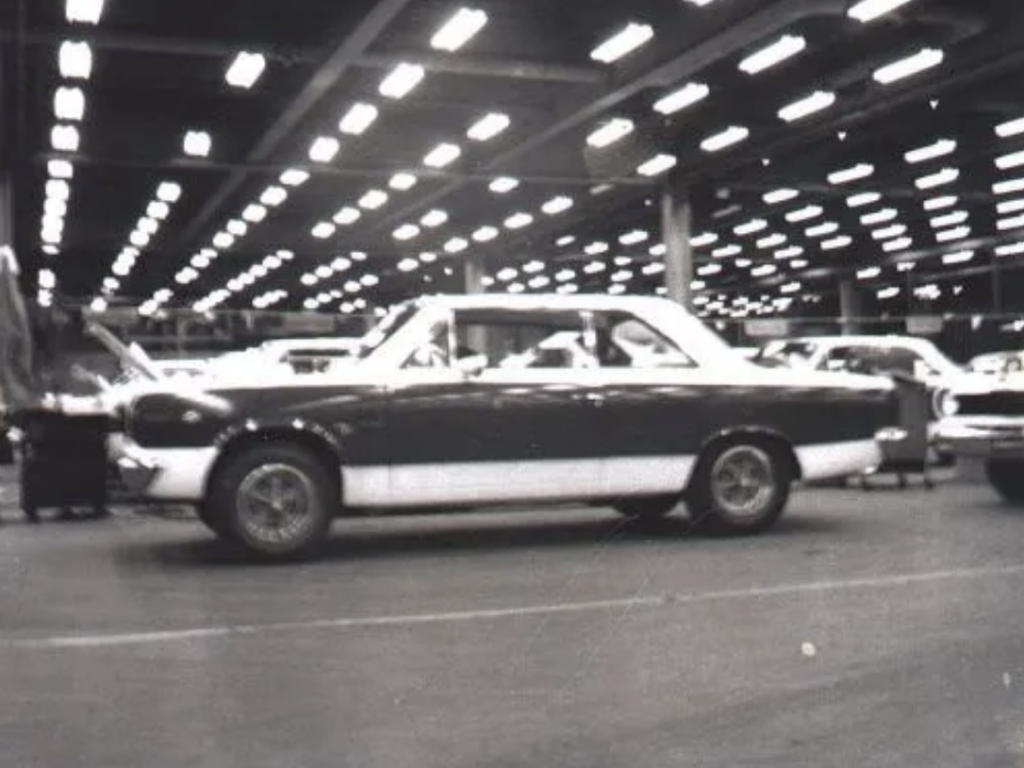
Now there is a problem if you just look at a photo without further investigation. This is a photo of a number of SC/Ramblers. Compare it to the SS/AMX photo number 1. Does this look like the same building? Same walls, lights, windows, height of ceiling, etc? No, it is not the same building. Where is it, then? I was told this is a warehouse used by H L Shahan to store and work on the SC/Ramblers sent to him for the press runs at Orange County International Raceway, but later told it was in the factory where the cars were stored awaiting pinstriping. And then I found this photo and published it in the New England AMX Club newsletter, the AMX-Press:

Though the picture is celebrating an AMX milestone, look what is onthe assembly line behind the AMX? Yes, proof positive the SC/Ramblerwas made on the East Assembly line in Kenosha.
Here is another picture:
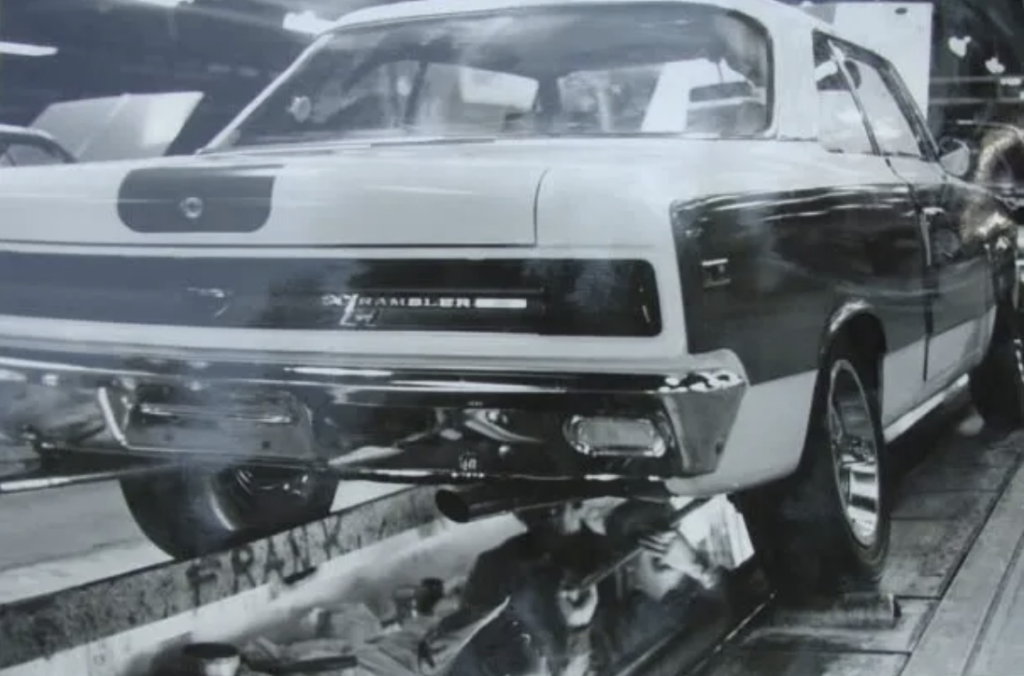
More AMC myths exposed.
So just what was done to these cars at Hurst? Here is what was written in the original letter to the dealers:

So the cars started off as a regular production AMX with a short option list. All cars painted P72A Frost White (and this is very different from a “body in white”, which is a unibody assembly in primer, not painted).
The cars had a charcoal interior and were equipped with a390 4 speed, posi rear with 4.44:1 gears, manual steering, manual drum brakes, no undercoating (which was an option, so it was not added to the option list), and no sound deadener (which is carpet sound deadener, not body sound deadener). No radio, no clock. They were not Go-Pac equipped, so no stripe. To start. We have proven it had rocker moldings.
Now, what about mirrors, wipers, heater assembly? Spare tire assembly? Wheels and tires? More later.
Here are two build sheets:


Here is a blank Build Sheet from 1969 (Note the date in the upper right is the date the sheet itself was approved, not for the data on the sheet)

The Sequence Number on a Build sheet is really the Body Number from the door tag. This is the sequential number of Javelins and AMXs coming down the line of the Body Plant. This particular number is R022185 on the first sheet, R022203 on the second sheet, showing they were made the week of January 11, 1969. They are 18 cars apart. (Note: The cars did not come with a door data plate. Why would it? They did NOT conform to Federal specifications, and the door data plate was to show they did!),
The Serial Number is the last 7 digits of the VIN, in this case X213585 (Car #26) for the first sheet, X213589 (Car#30) on the second sheet. Here, they are 4 digits apart.
Haven’t broken down the “Order No.” yet, but you can see they are 18 digits apart. (18 the other way from the Sequence Number).
It was a common practice to build the bodies and ship them to the final assembly plant not necessarily in the same order. Therefore, the Body, Sequence, and VIN number were rarely in sequence.
The Zone shows “00”. This usually stands for a factory based car, so is correct.
The car will be shipped via ground “G”. It is an AMX (39-7), with the color 72 Frost White and interior 31F, charcoal vinyl. The tire code is “00”. Interesting as I don’t have this code. I was told the car was delivered on Javelin spare tires on black rims, and there are pictures of the cars with black rims and skinny front tires. Another source shows E70 x 14 blackwall tires. At any rate, the “00” could also mean a special order wheel color, as black was not the standard wheel color for a frost white car.
A “2” in seatbelts and a “1” in headrests are standard for 1969.
A “9” for engine is a 390, an “M” for trans is a 4-speed. Gear Ratio “F” I have as 3.54:1, standard on a 4-speed AMX. These were changed to 4.44:1 as shown in the Special Instructions” section of the sheet. A 5.00:1 ratio was available later in Spring for these cars.
No number in “DE”, Dual exhaust. Interesting there is no number because it did come with an exhaust. A “1” in “TGD” shows it had a twin grip differential.
Next line: “WE” is Weather Eye, for a heater. The “9“ shows Command Air. This doesn’t make any sense. More research needed. At any rate the heater was not installed on the assembly line and the car received block-off plates. (A large one for the heater motor, another for the heater core, another to take the place for the heater control, a block-off for the defroster ducts (made of cardboard), and lastly a plate that blocks off the opening where the fresh air would flow through the heater core through the cowl vents.
I do not know what the “6” is in TS LGR. I haven’t seen this on other AMX build sheets. TS stands for “Third Seat” and LGR means “Luggage Rack”, codes used for wagons. AMC did put codes in boxes that were not standard for that model to designate something (the Donohues I am pretty sure had a “4” in the box for cruise control, an option not available on the Javelin)
The “1” in HDC LDC is for Heavy Duty Cooling. The “1” in HB is Heavy Duty Battery.
Under Special Instructions, assembly line workers were told to delete sound deadener (under carpet) and hood insulation, install special 4.44:1 rearend gears, and allows for “deviation of No. 96”. Sure wish I knew what “deviation of No. 96″ was- anyone care to guess?
By the VIN, the first sheet shown here would be car #30; the second would be #26. However, Hurst assigned them their own numbers.
I also wish there were other Build Sheets for the other cars.
From letter #2 from American Motors:
Hood scoop and induction
Special Manifold and Carbs
Clutch and Bellhousing
Modified Cylinder Heads
Relocated Battery
Modified Suspension
Altered Wheelwells
It also stated it was not for street use, did not pass emissions, and had no warranty. And noted the car did not conform to emissions standards (could this be the “deviation of 96”, meaning no emission controls on the engine)? Being a 4 speed, the car would have a smog pump and all related components.
No mention of pistons at all. No mention of a different shifter assembly, or parts. Does modified suspension also mean axles? Or just shocks and springs? Any other deleted items?
This could be answered in the third letter from Hurst. A number of dealers were unhappy about the readiness of the car, and let AMC know just how unhappy they were. To answer this, AMC performance sent a letter to the dealers that ordered a car:
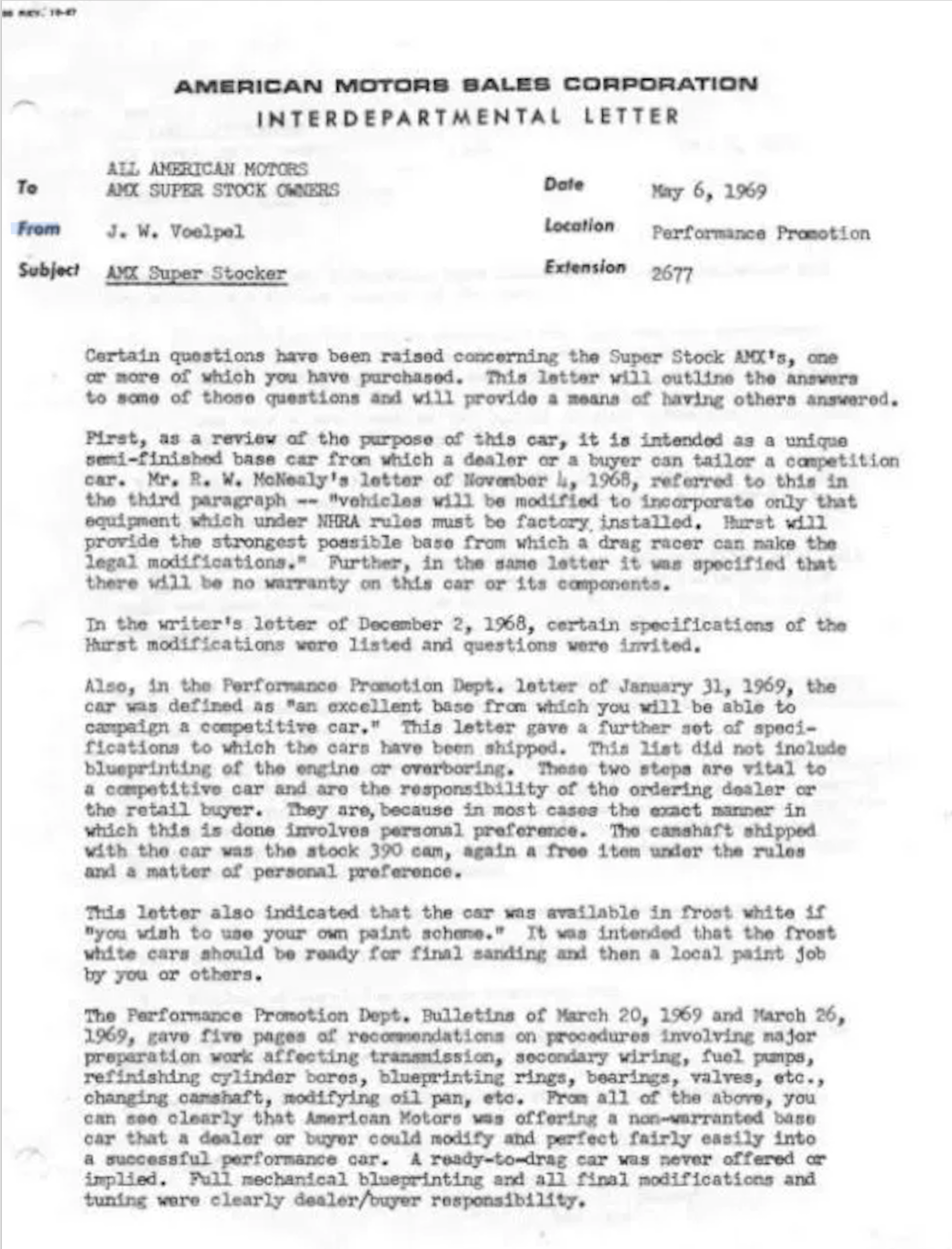

HMMMM. “One of which you have purchased” Why would Cox get this at his dealership? Could this mean he actually ordered an SS/AMX? He got this letter, and that is what it states, right? I would say yes. But…look at the date. This could not be for the car formally owned by me because that car wasn’t even on the production line when this was sent out.
And look at the signature. More here:

So Chakmakian is gone.
What a shocker for the dealers who ordered this car! “Only those items needed to be installed per NHRA specs!” Who would have thought that and read into it when the first letter came out? Dealers were outraged! They sure seemed to have expected the car to come balanced and blueprinted, and maybe even overbored. They definitely expected a deeper oil pan and a driveshaft loop.
And I wonder what the mention of the paint job meant? When I asked Watson about the car’s paint, he stated that Hurst was not a paint shop, and didn’t paint the cars. This seemed to make sense with the delivery of the Hemi Darts with an unpainted nose. But again-this is “Hearsay”-no proof. I have been trying for years to find out how and where these cars were painted, but no luck. Probably a local shop. Plus, was a tri-color paint job extra cost? I would think yes. Later in the letter, there is a mention of tri-color paint, so they obviously came that way. I was told the teenage son of the owner of Ferndale Auto Body quickly painted some of the cars, and after he was paid he took off to spend the money without painting any more. (Not confirmed info).
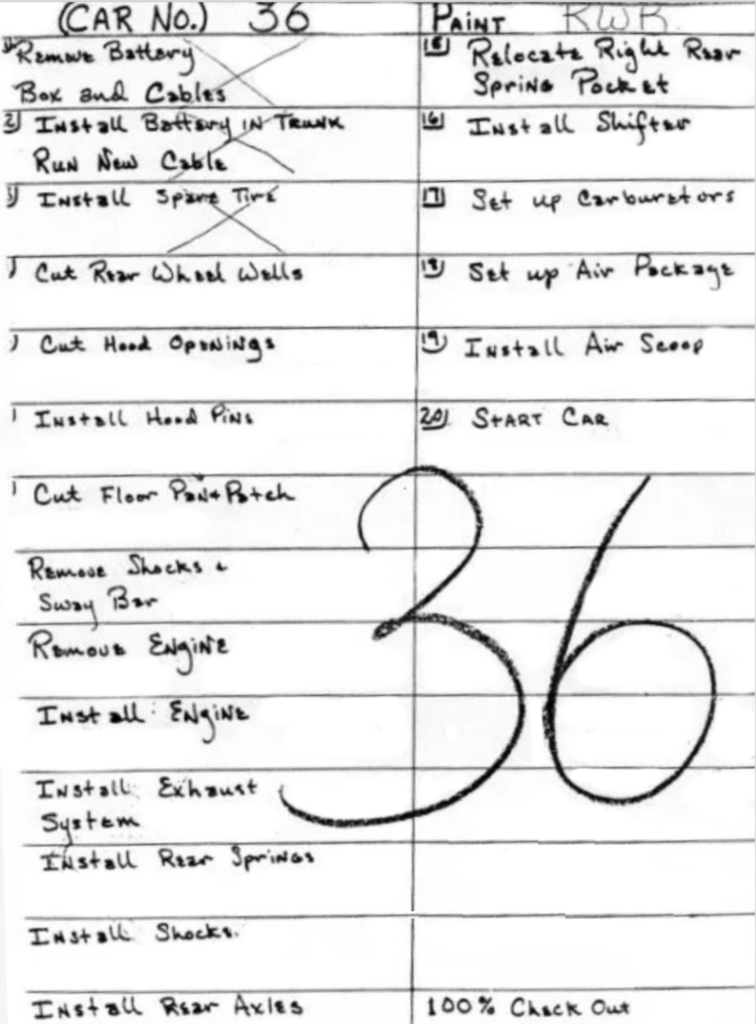
While at the Hurst facilities, a sheet was put on the windshield with a checklist and car number. Here is an example:
Here is a cleaned-up blank:
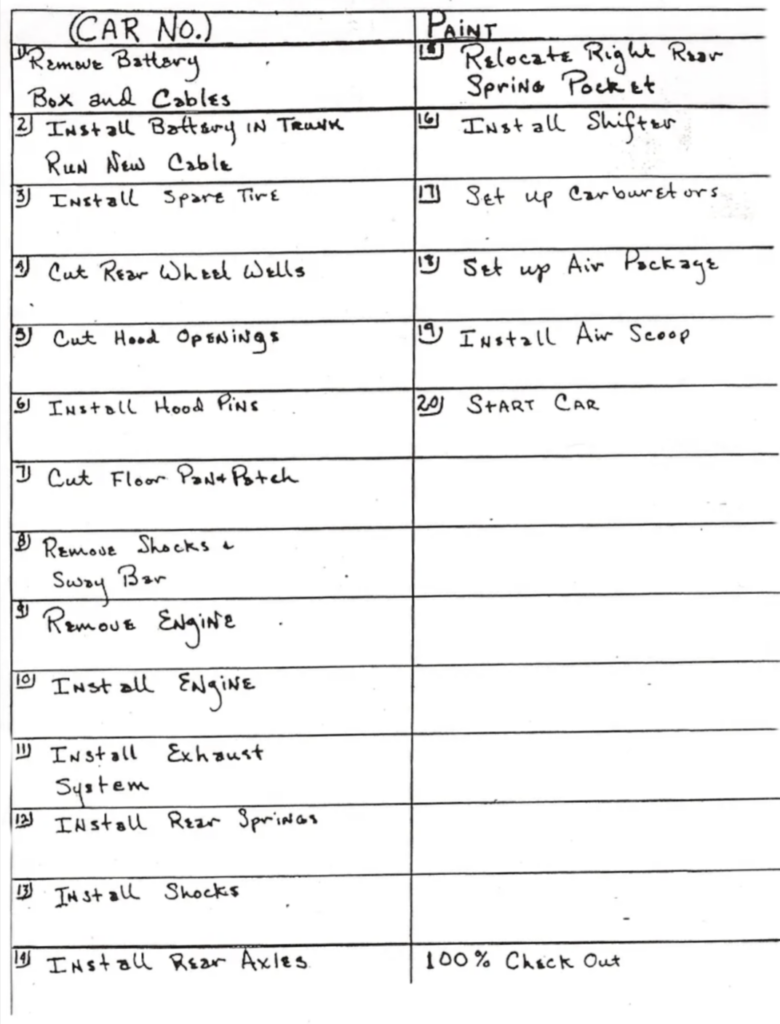
The sheet designates the Hurst car number (which were randomly assigned to the cars) and if it was all white, or red, white, and blue.
Some interesting work: cut and patch floor pan. Know why? More later.
How about “set up air package?” What is this?
There was also a sheet for the engine.
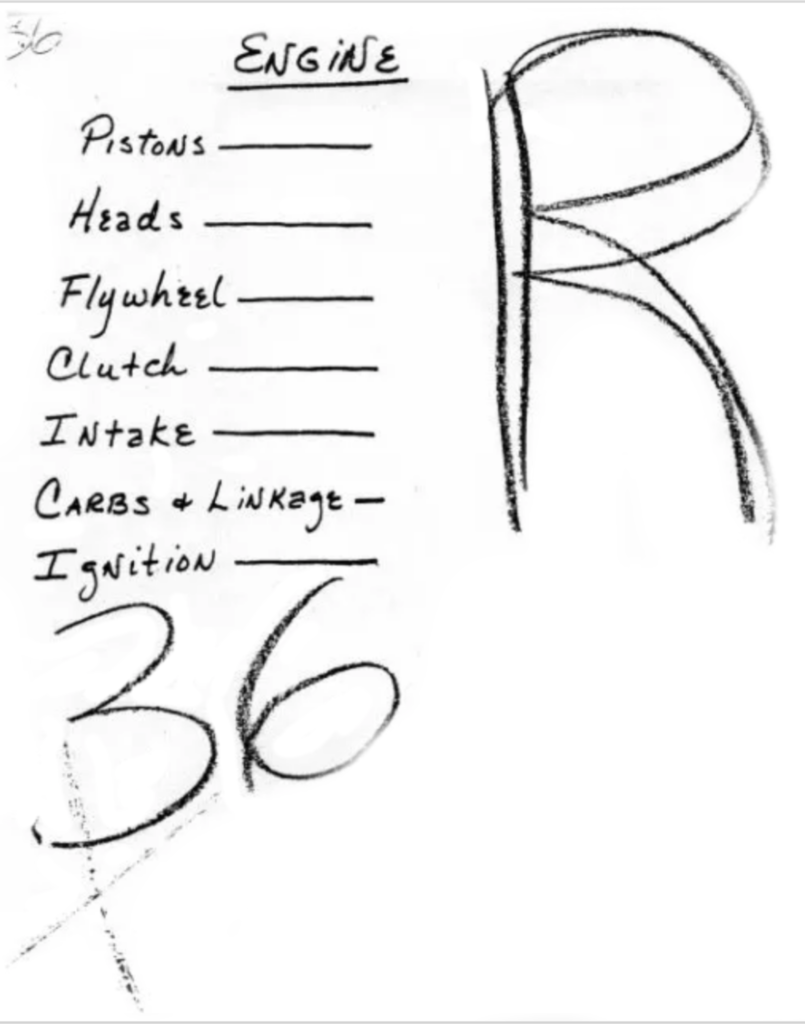
Luckily, there are two different cars with this sheet (though with their own numbers on it). Two items here not previously mentioned: Pistons and Flywheel. I wonder what the big “R” stands for?
So there is a missing document. I don’t have it, but hopefully someone does. This is the actual order form for the dealers.
This form would give the options for color, for instance. It would specifically spell out what comes with the car, and what does not come with the car. It would determine the paint scheme. And most importantly, it would show prices. The original letter showed a price of about $5000, yet it is reported they cost almost $6000. That is a HUGE difference for 1969.
Now here is some NHRA update Tech Sheets:

Note the carb type-a Holley 4584, with AM part #4487187.
Here is a pic of the carb numbers: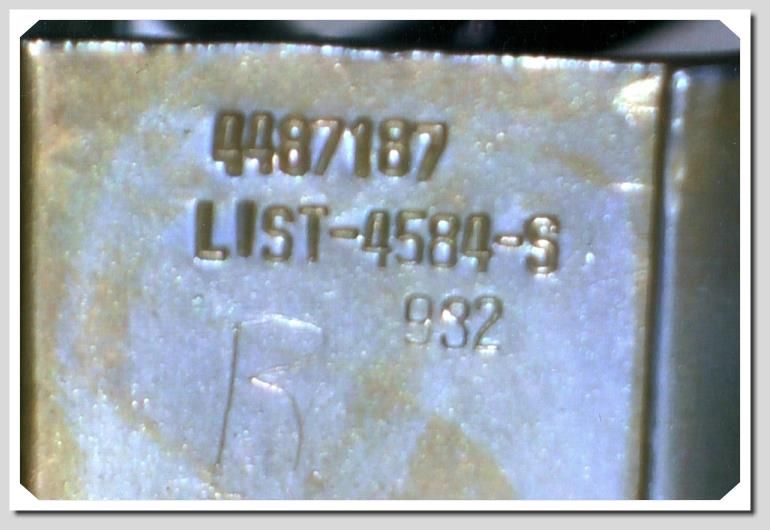

NHRA Technical Specifications
Issued: 1 March 1969
Revised: 4-1-69, 4-17-70, 7-17-70, 4-1-71, 4-26-74
6-24-95, 2-4-05, 12-21-05 WR, 8-3-06 WR
Bulletin #: Amer-69 Page 1 of 1
Specifications for the 1969 American Motors engines
H.P. Disp. C.R. Ind. Make Model/Transmission Manifold R.R. Lifter Head cc Notes
315 390 10.2 1-4 Cart AFB-4664S/SM 4665S/AUTO 3191736-C 1.6 H 49.10
340 390 12.2 2-4 Holl 4584/SM ONLY 4486228 1.6 H 57.00 2
Notes
2 Super Stock Only Carb size 1562×1562/1250×1313
Deck Piston Type
H.P. Disp. Cl Dish/Dome Ht Vol Valves Cam Lift Springs Gasket Head Cast Notes
315 390 .028 FLAT w/trough 13.94cc 2030/1630 425/425 Outer Only .040 3188558
340 390 .038 DOME w/n 3.60cc 2080/1740 425/425 Outer Only .030 558,291,993 A
Notes
A = “O” rings may be used in the heads or the block if desired.
It is not mandatory for a racer to use “O” rings, it is optional. A head gasket must be used in either case.
This brings up some questions. First is pistons. It isn’t mentioned in earlier letters, but does show up in the engine checklist. I have seen a number of brands mentioned, but my question is: the parts were only supposed to be things the NHRA needed changed. Were pistons one of these? What is really silly to me is for the company to put standard bore pistons in the car, plus no blueprinting/balancing. Then, they send out a notice on how to make free floating pins! Well, the answer is the domed top of the piston. AMC had to install these so the racers could use them. The racers could overbore the cylinder as much as they wanted, but would have to use flat top pistons if AMC didn’t put these domed ones in. And there is a story that one racer used a piston with a different top design for the valves and had to change them.
Anyway, here is a letter from Brian Higgins to me from the late 80s. He sent me an article that was written about his car (Westbury Rambler’s S & K car). You can see his writing in the margins:
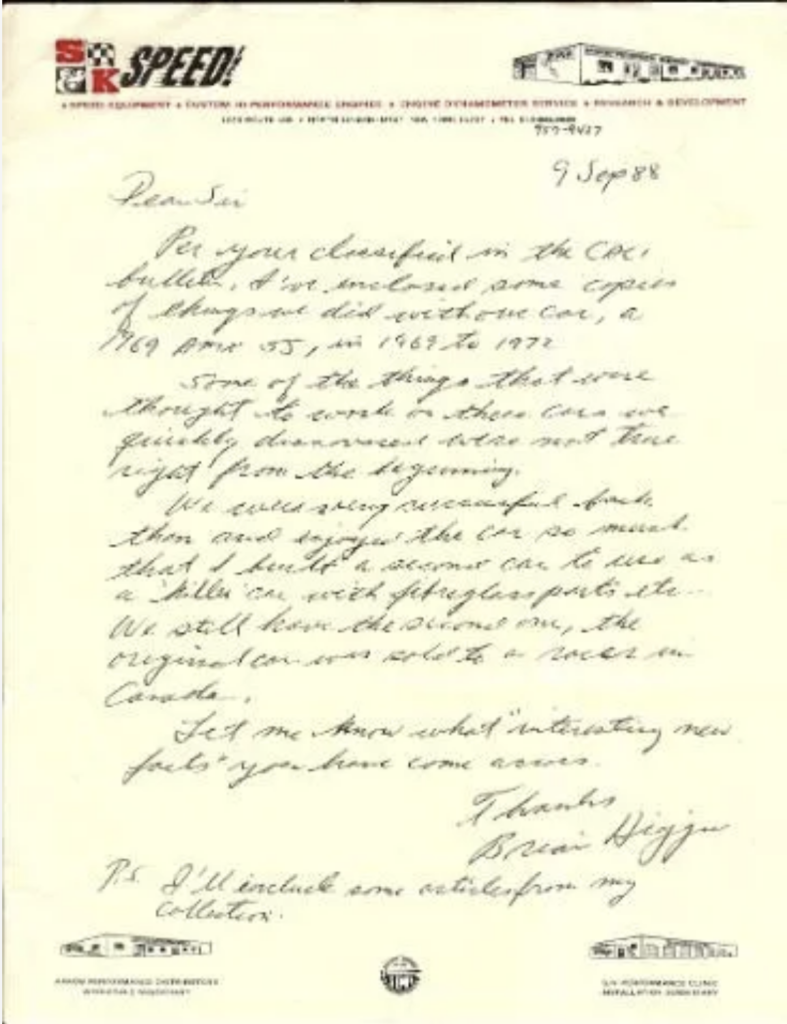
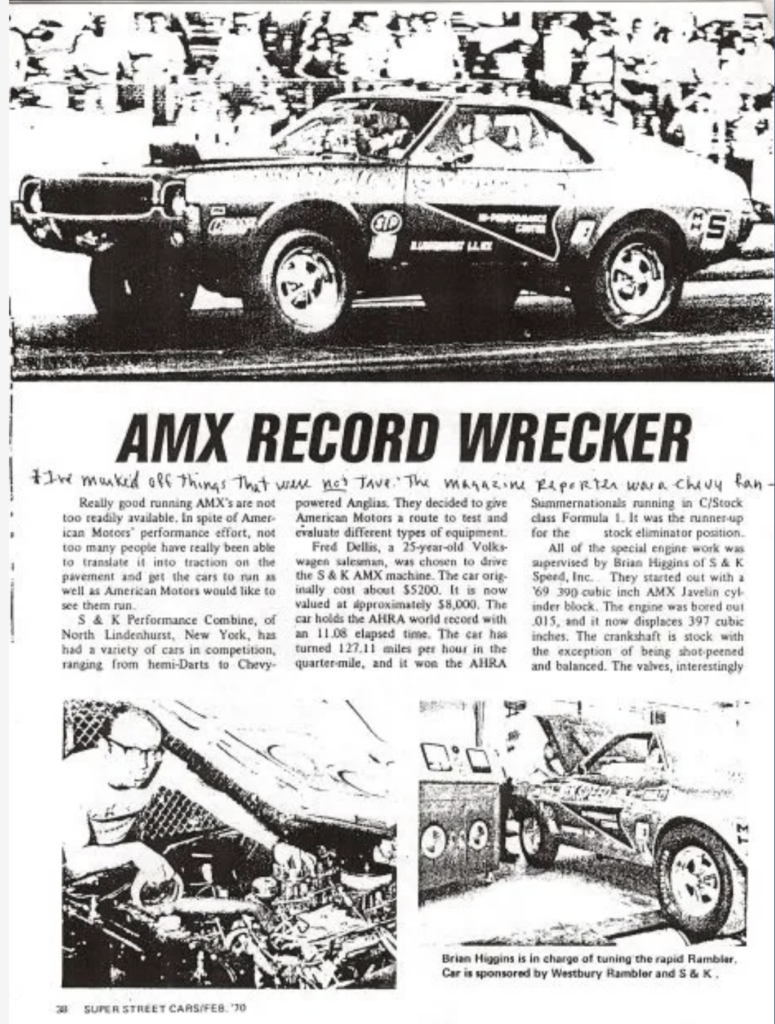
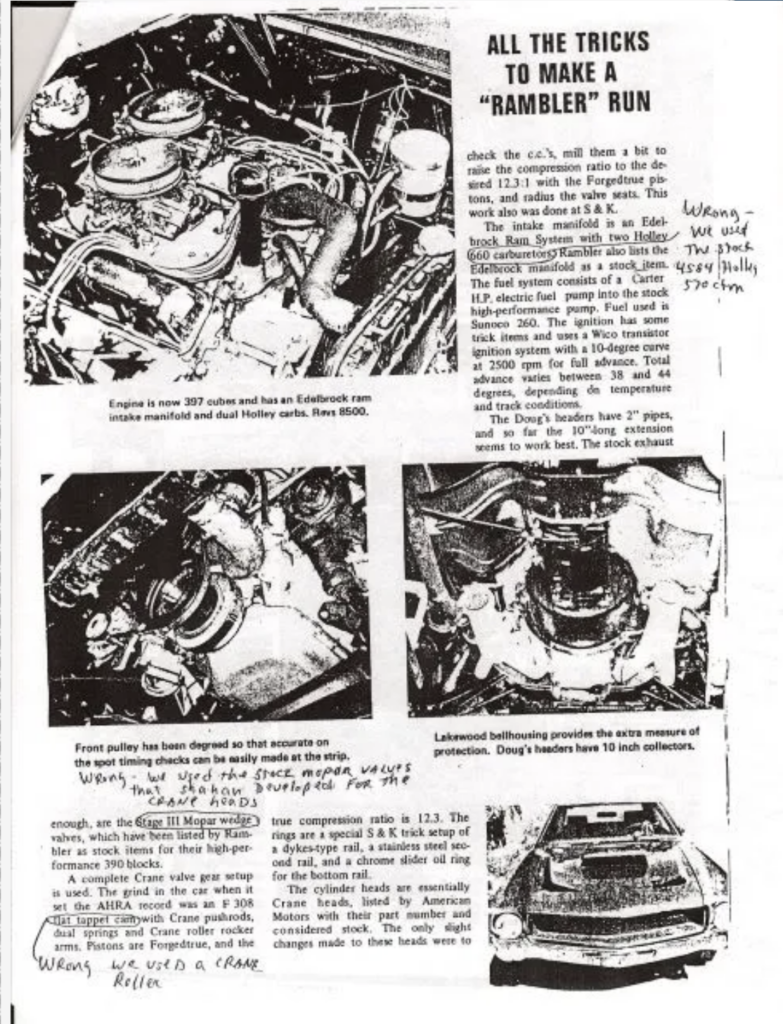

Here is a better copy of the article, scanned from an original magazine
(Super Street Cars, Feb 1970):
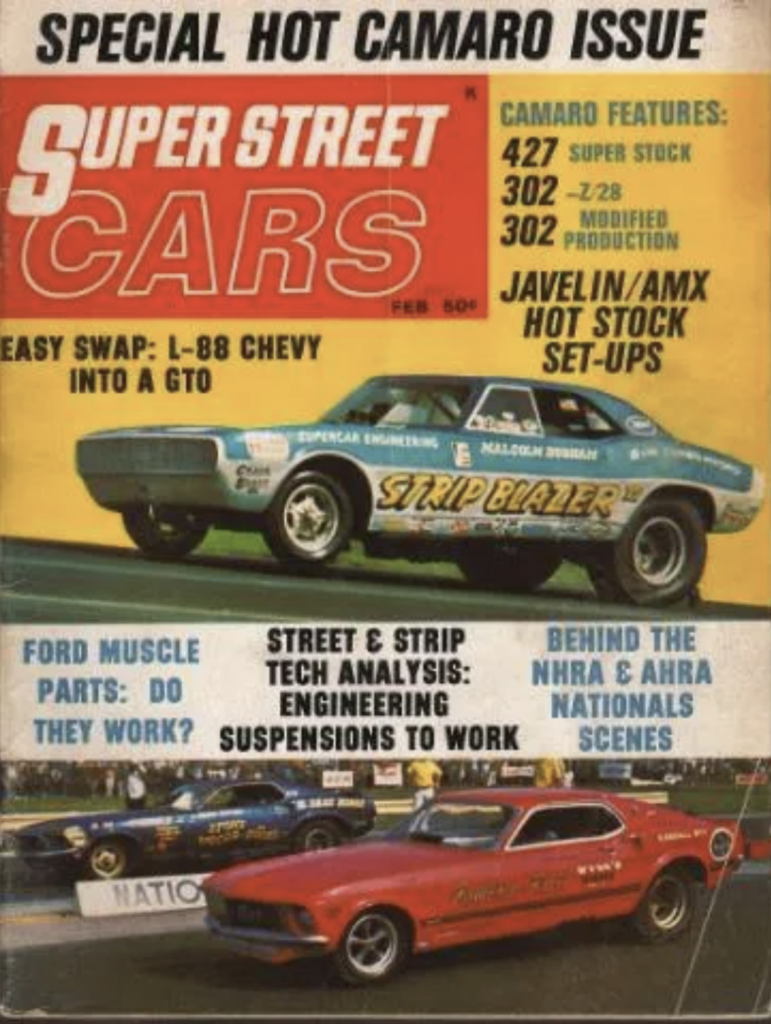
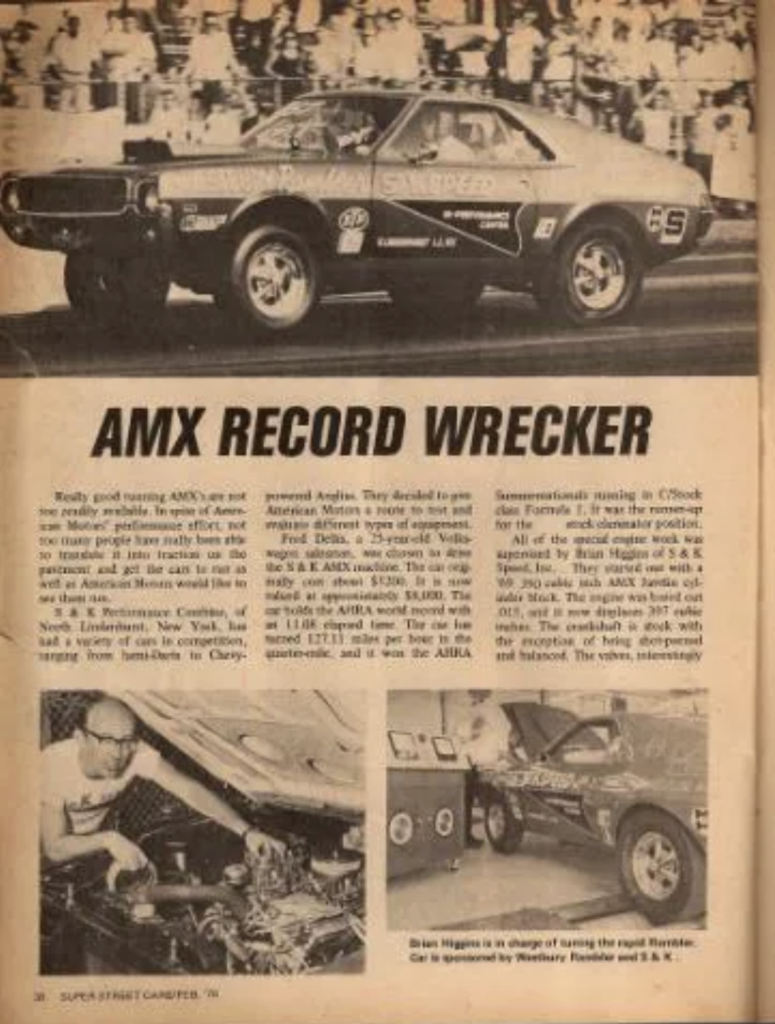

Nope, this isn’t going to help as they talk about what pistons are in the motor, but not if they came that way. I say this as they also talk about the cam in the engine, and they were definitely NOT changed from factory. (Because there are a number of factors that go in to selecting a cam, to include altitude, so a Boston cam would be very much different than a Denver cam. Thus, the factory-stock cam was left in the engine). I’ve also heard from owners that Hurst did nothing to the bottom end of the car (we know they put on a stock oil pan. Seems crazy that they would pull the pan to replace the pistons, then put the stock pan back on. How much more would it cost to put a deep pan and pick-up in?) JE seems to be the piston company verified by most owners. That is verified with this notice found in a period drag publication Drag News:
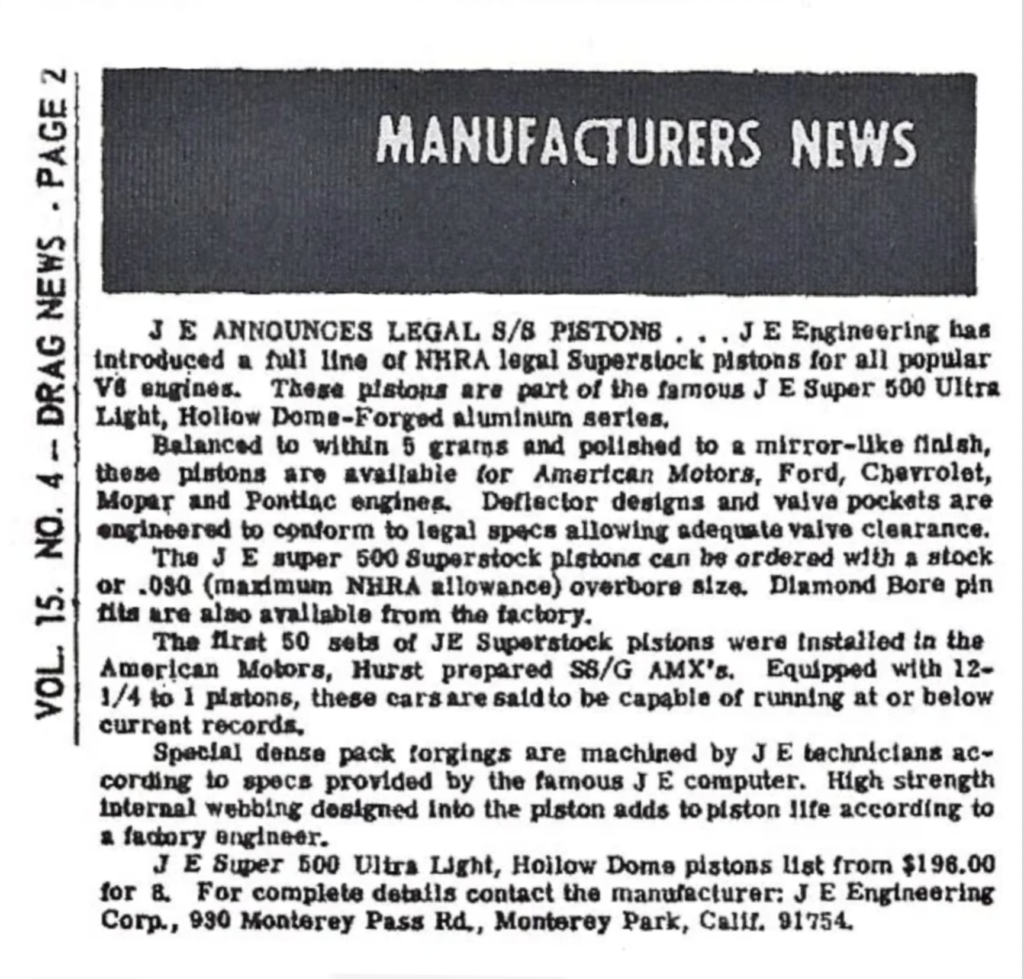
And please note the carbs again. I have seen everywhere carbs from 600 to 650 cfm.
Hurst put two Holley 4584 carbs on the intake (and I may be thinking of something else, but were they
also labeled “L” and “R”?). They are 570 cfm, and ONLY came on the SS/AMX cars, so sure have a premium price on them.
Let’s look at an article from Car Craft June 1969
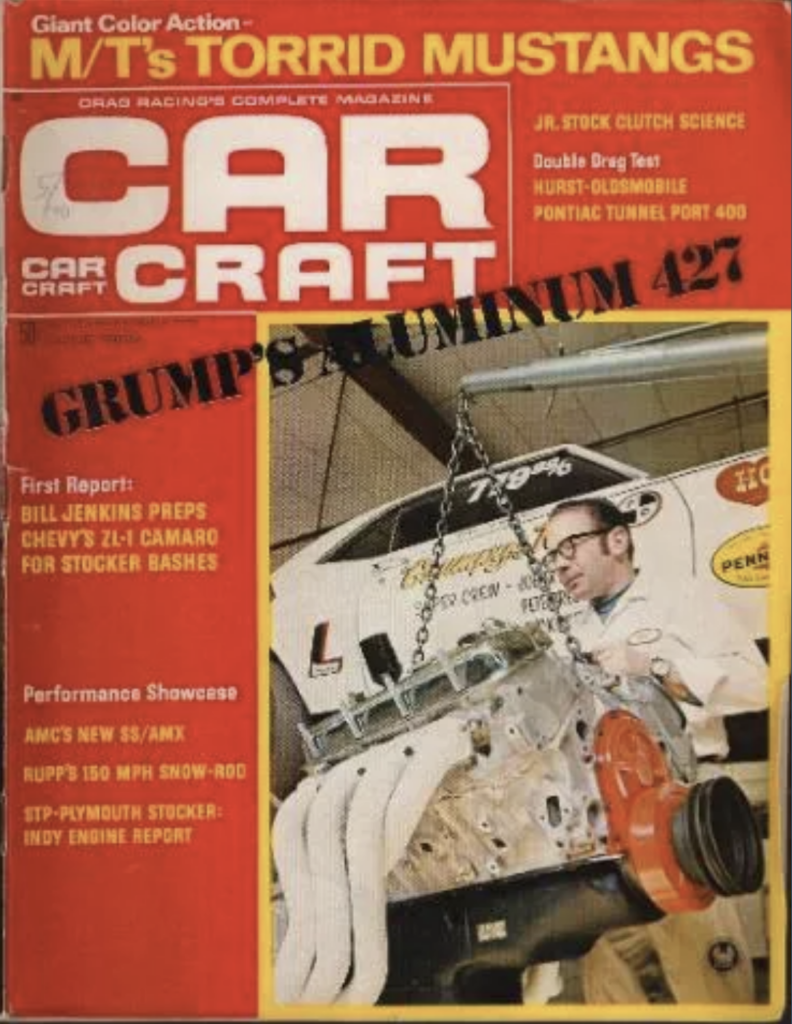


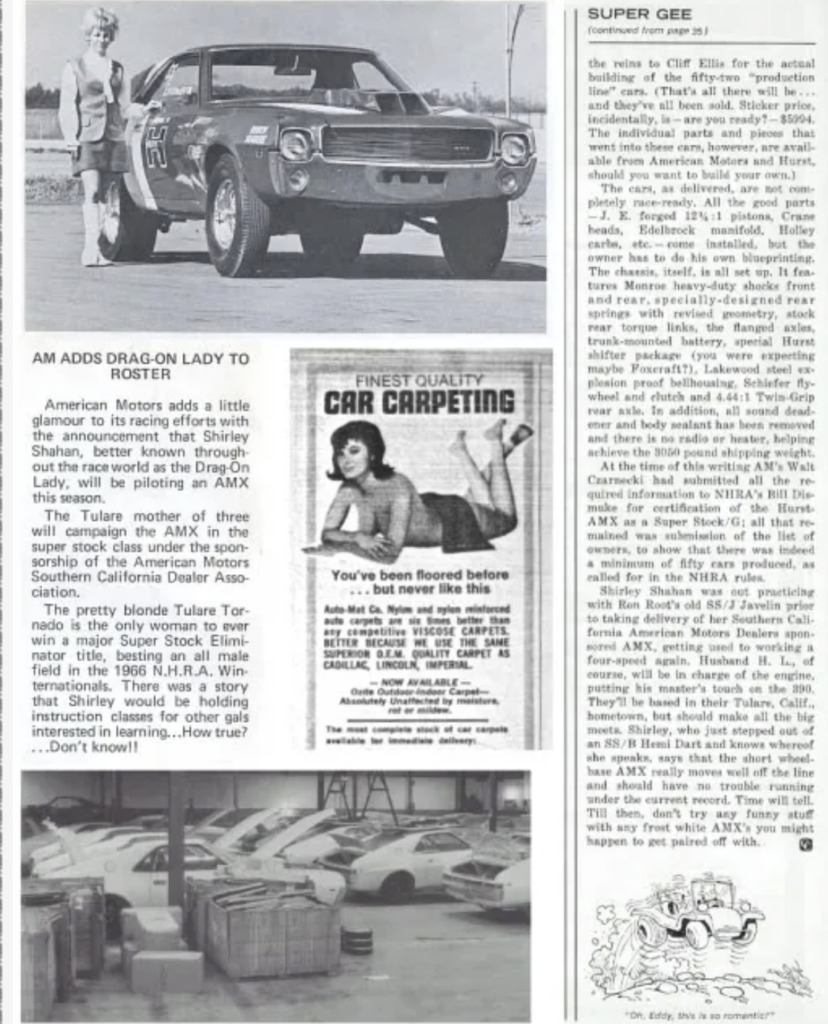
First, there is mention that “most” of the cars were sold to dealers. I wonder how many were sold to a private individual, and how they found out about it?
The prototype car originally ran an R4B and Holley 3bbl, and the heads were done by HL Shahan at Hurst. They decided to send them to Crane when the project got going because they just did not have the time to finish all of them at Hurst. As we all know, the intake became the Edelbrock STR-11 Cross-Ram.
The stock horsepower for a 1969 390 engine was 315 hp. The magazine mentioned that after some more tweaks, to include the crossram, they were able to get ANOTHER 28 horsepower from the car. Let’s see, that equals 343hp, yet the car was rated for 340-and this does not include the horsepower increase with the R4B, etc.
Wonder what the real horsepower on the prototype was?
The article mentions Holley 4210 615 cfm carbs. We know that is wrong. I wonder how they determined the carb size for the final build, especially when the bore/cam was still to be determined by the new owner?
“That’s all there will be.” How did they know? Here is a part that bothers me. There is documentation that shows the beginning VIN sequence. There is also mention the names of the owners will be sent to the NHRA for certification, or homologation. But where does it say there will be no more made? And they only had to send 50 names and VINs to the NHRA for certification, why would they have to send other names once the car was homologated? There is no documentation that I have seen or heard of that says “this batch, and no more.” Remember the mention of the Hurst Hemi Dart? They made 50, then later made 30 more. Hmmmm.
Original parts and pieces are available from Hurst and AMC….” I will look and find these prices in 1969. There is a mention of the almost $6000 price for the car, a huge sum in 69. JE Forged 12.25:1 pistons. Someone must have a program to see hp ratings with the various parts on the car. Total weight 3025 pounds. Didn’t it weigh about 3200 when new?