
***Please note-some of these images were taken from various sites on the net. However, I do have the original copies of the documentation and factory/magazine pictures.
***I do NOT have copies of many of the color pictures on the web and do not take credit for them. If you know the photographer of these pictures please let me know so I can give proper credit.
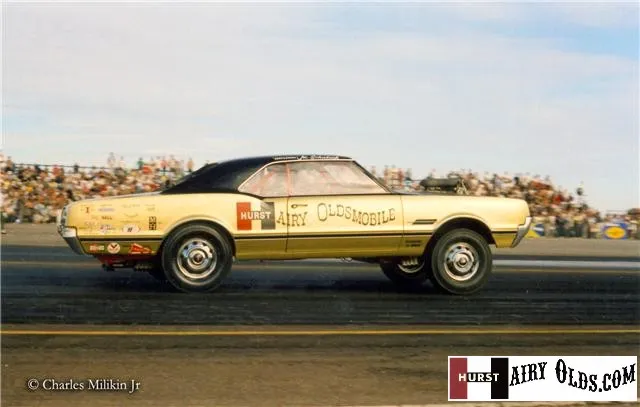
When George Hurst left the Navy he opened a repair shop in Philadelphia and quickly became known for his engine swaps. This was made easier because he developed a set of motor mounts that allowed for a number of engine and then later engine/trans swaps. The tranny swapping was a natural beginning to an industry creating shifters. Hurst eventually contacted enough buyers that he built a production facility in Warminster, Pennsylvania to go along with his research facility in Madison Heights, Michigan. Jack “Doc” Watson was hired as an engineer to work in Michigan and he quickly became involved in some special projects, most notably the Barracuda wheelstander “Hemi Under Glass” and the “Hurst Hairy Olds.” Here is an early showing of some Hurst cars at the drags:
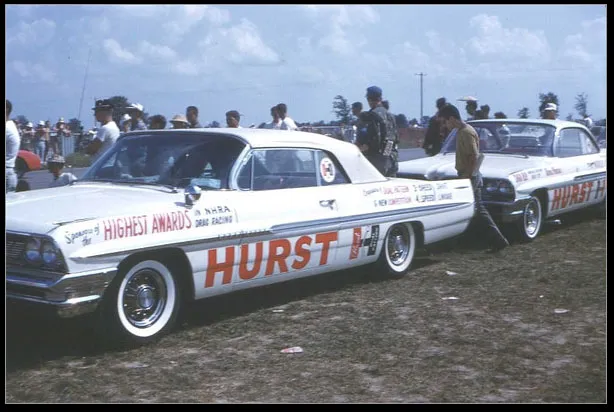
Hemi Under Glass wheelstander (Named because the engine is under the big back window):

Hurst Hairy Olds:
Hurst’s biggest break came when Pontiac agreed to sell his shifters as a dealer installed part in 1963, then made them OEM (factory installed-Original Equipment-Manufacturer) in 1964.
Other auto makers followed suit, and soon the Hurst shifter was available in most muscle cars right from the factory (AMC in mid-69, to coincide with the new Hurst inspired SC/Rambler).
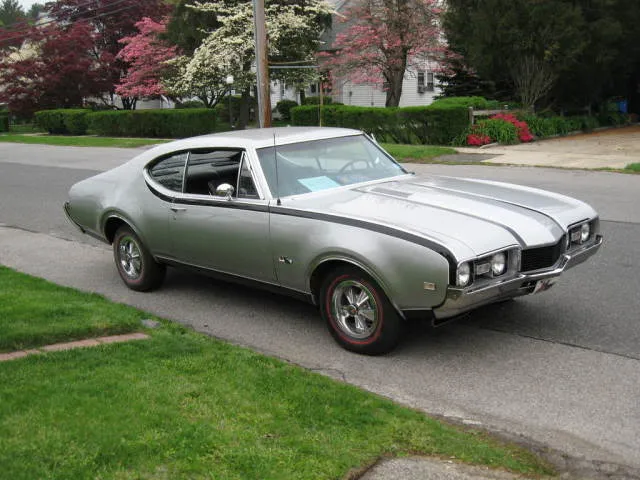
In 1968, Watson made a special Oldsmobile for George Hurst. George convinced Olds to make the car, and in June 1968 the first of a series of Hurst Olds were made. The cars were made in the Lansing, MI assembly line, and then sent to Demmers Tool and Die Company (in an old warehouse) for assembly.
These were NOT done at the Hurst facility. Here is one:
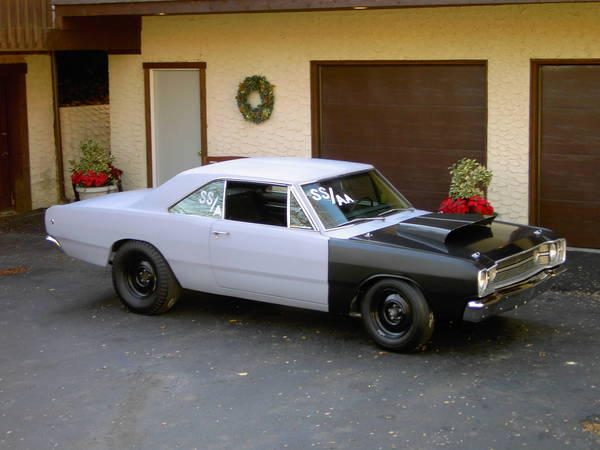
Also in 1968, Hurst contracted with MOPAR to make 50 Hemi Darts and 50 Hemi Barracudas. (50, as that was what the NHRA required for homologation). Final tally was about 80 Darts and 70 Barracudas. These cars were sent to Hurst minus a number of components, to include the entire front-end sheetmetal! Some of the changes for the car were fiberglass front-end sheetmetal, with a huge scoop on the hood. Plastic windows were used, and the door mechanism to roll up the windows was missing- instead, straps were used to open/close the windows. The car used Dodge van seats, and most importantly, the 426 Hemi engine. A number of items, such as the heater, were deleted.
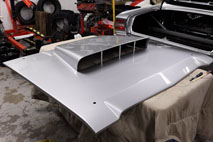
These cars were made at the Michigan Hurst facility. (An interesting note-the front end was kept natural fiberglass black color-no paint). Here is a picture(and the scoop-though larger- should look familiar to the AMX scoop):
Various reports from the web:
“In 1968, Dodge released one of the most feared drag cars ever: the 1968 Hurst Hemi Dart. Dodge would ship Dart body shells to Hurst”
“In 1968, Dodge released one of the most feared drag cars ever: the 1968Hurst Hemi Dart. Dodge would ship Dart body shells to Hurst and they wouldinstall a ram-inducted 426 cu in (7 Liter) Hemi V8 under the hood. Using fiberglass fenders and hood, belt straps for window cranks, and A100 seats for decreased weight, this car and its sister car, the Hurst Hemi Barracuda, would dominate Super Stock for decades to come; in fact, it still does today.”
“During the 1968 model year, between 50 and 70 (reports vary) Dart 2-door hardtops were fitted with the 426 Hemi engine. These cars were purpose-built race cars, did not come with a warranty, and were not intended for street use (although some enterprising purchasers did manage to register them). They are variously known as Super Stock or “LO23” Darts, the latter taken from the first four digits of their VINs. The cars were built without engines and shipped to Hurst for completion. Many weight-saving measures were taken, including omission of the heater, radio, and sound-deadening insulation. The cars also came with fiberglass front fenders and hoods, as well as lightweight Corning glass side windows that were raised or lowered with straps instead of the normal regulator assemblies. As an additional weight-saving measure, the standard bench seat was replaced by two lightweight buckets sourced from the Dodge A-100 van. The Dart’s rear wheel openings were radiused out to allow for larger tires. The cars were shipped unpainted, with black gelcoat on the fiberglass front clip and gray primer from the firewall back.”
There was one other interesting Hurst car with Dodge for 1968. New YorkCity changed the specifications for interior dimensions for their taxi cabs. Only the Checker could meet these. Dodge hired Hurst to lower the floorboards of 1500 cars so they would meet the New York specs. Who would think-a Hurst taxi!
At this same time, some point in early October 1968, AMC had some talks with Hurst about supplying the new shifter for their line of car, most notably the new for 1968 AMX and Javelin.
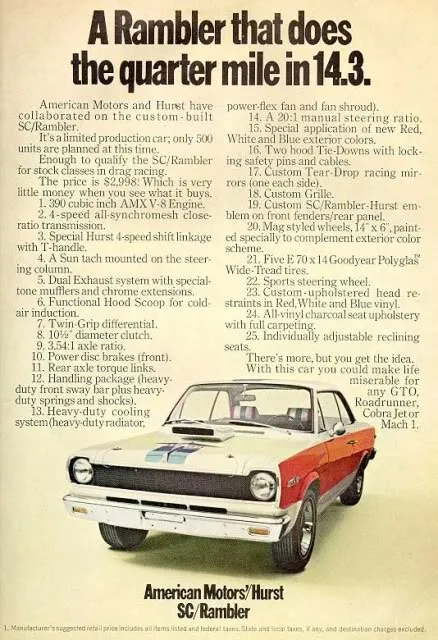
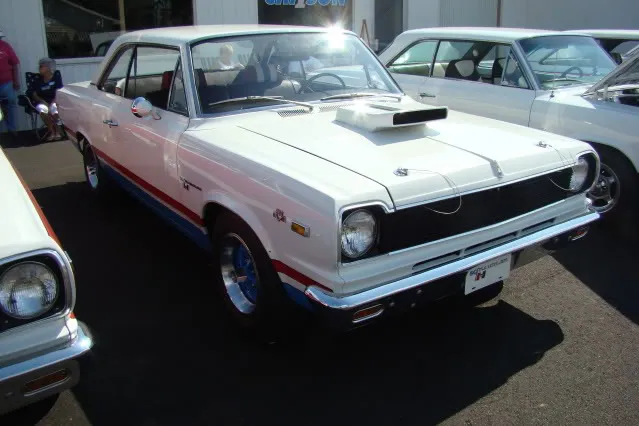
These talks for the shifter evolved into talks about building two cars for AMC: the Rambler SC/Rambler, an out-of- the-box street race car, and the SS/AMX, an out of the box quarter mile race car. Here is an ad featuring an “A”scheme SC/Rambler:
Here is a “B” scheme SCRambler:
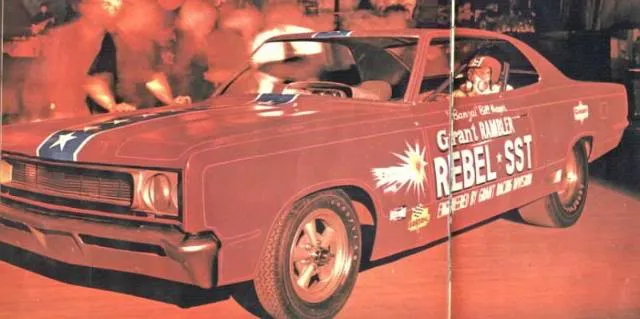
Work began on the cars, but I do not know exactly when. AMC already had a Performance Division in place, notably to promote the Grant funny car Rebel driven first by “Banzai” Bill Hayes, and when he was injured he was replaced by Hayden Proffit. A Performance Activities binder was sent to dealers with the promise of many future bulletins to help local performance events. Here are three dated bulletins:

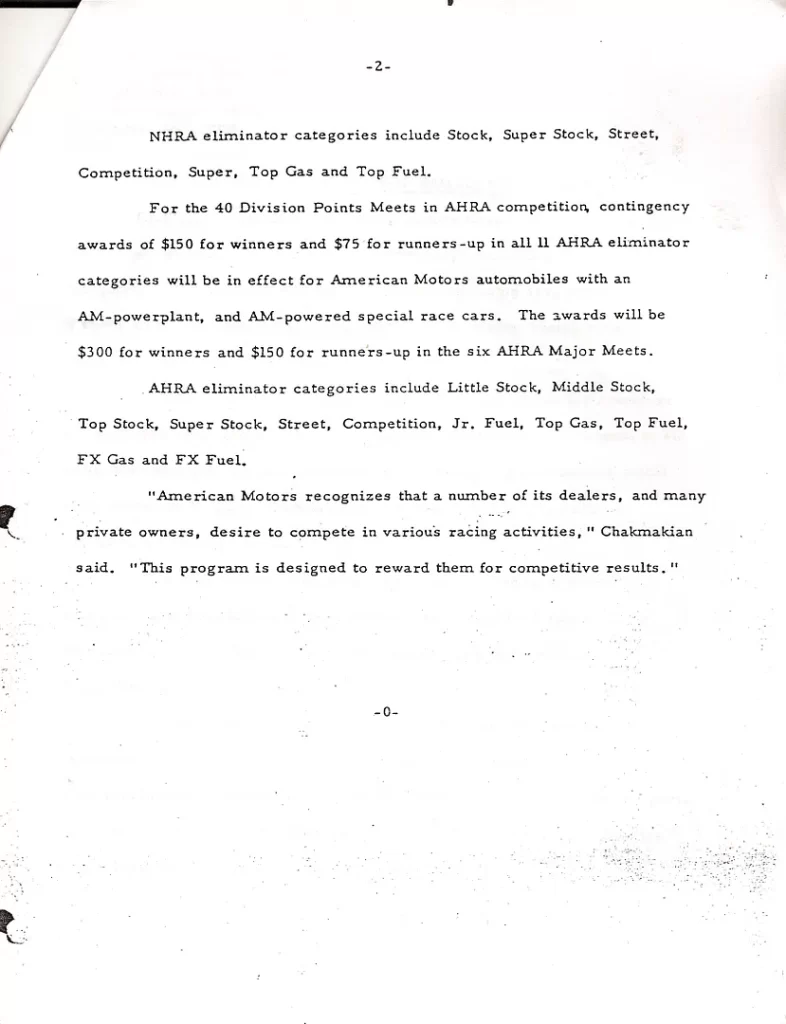
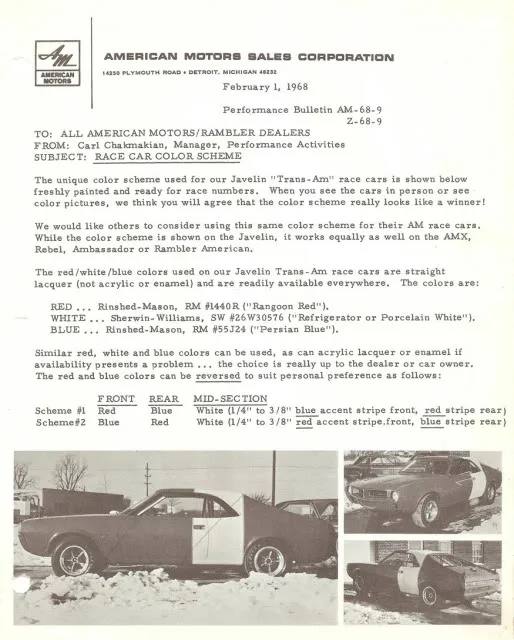
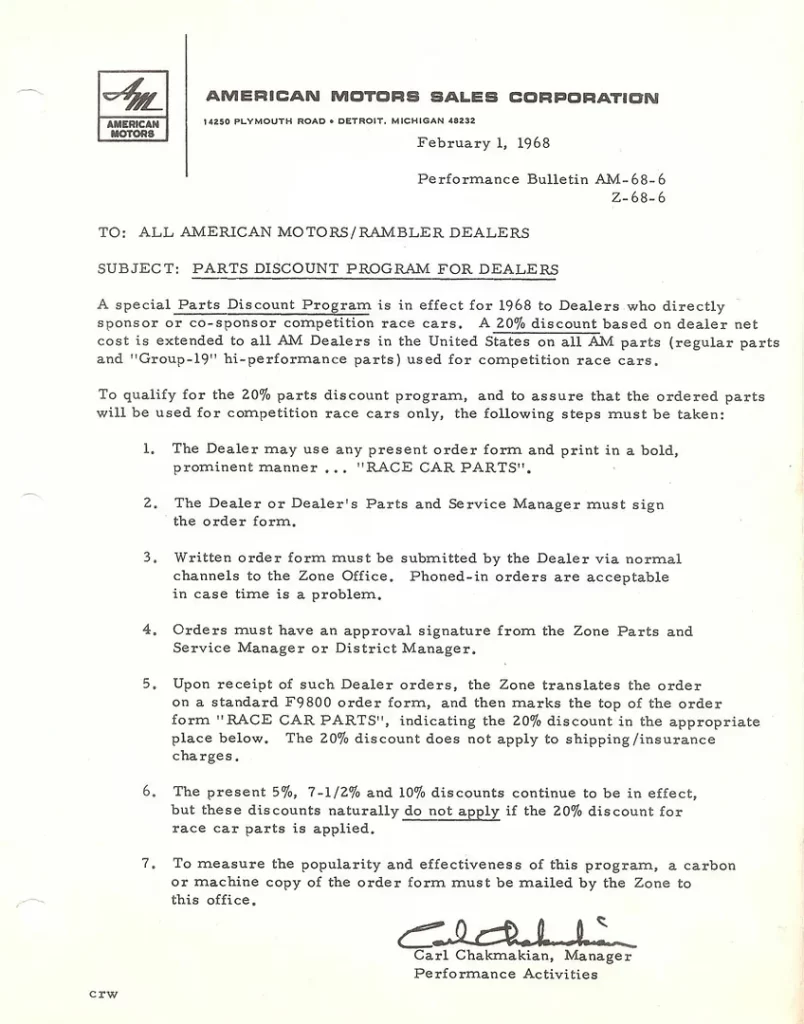
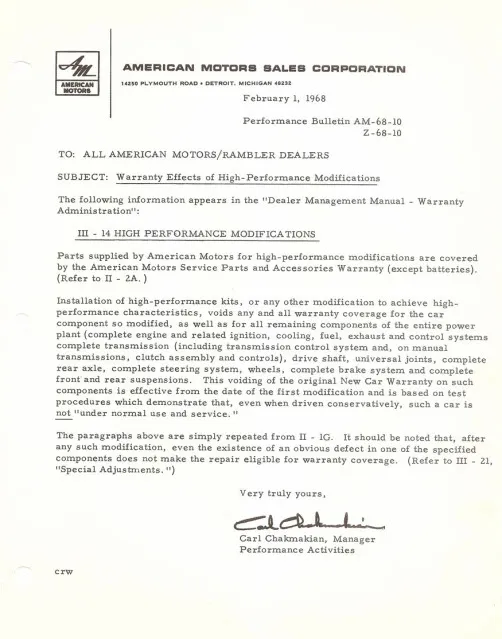
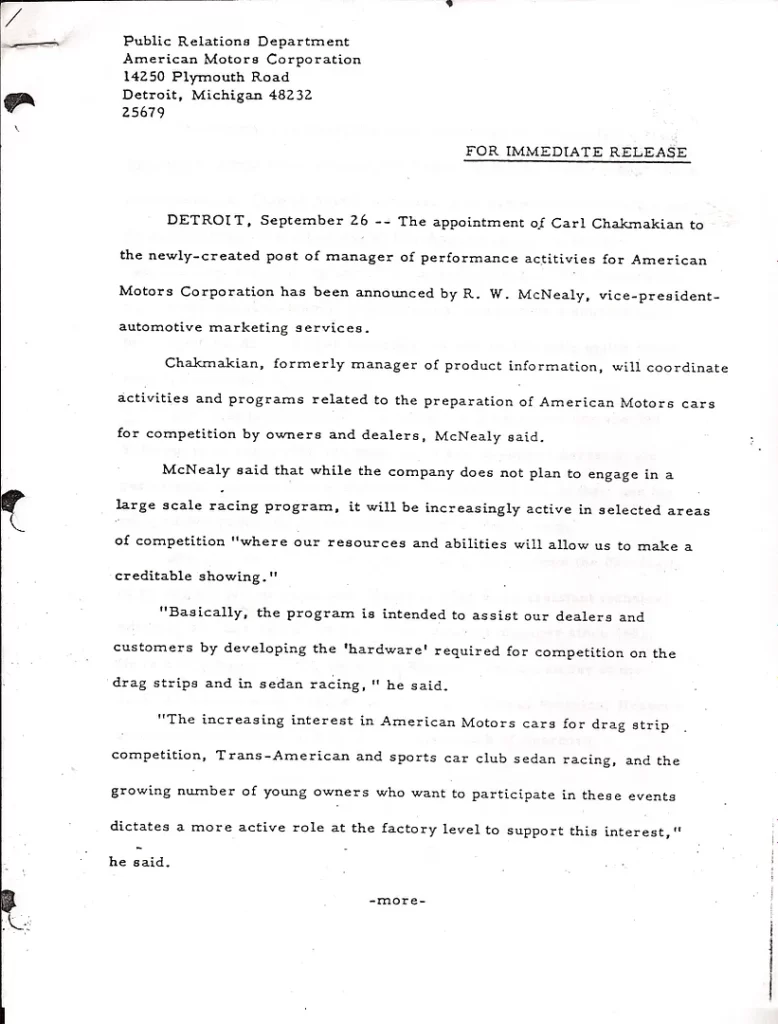
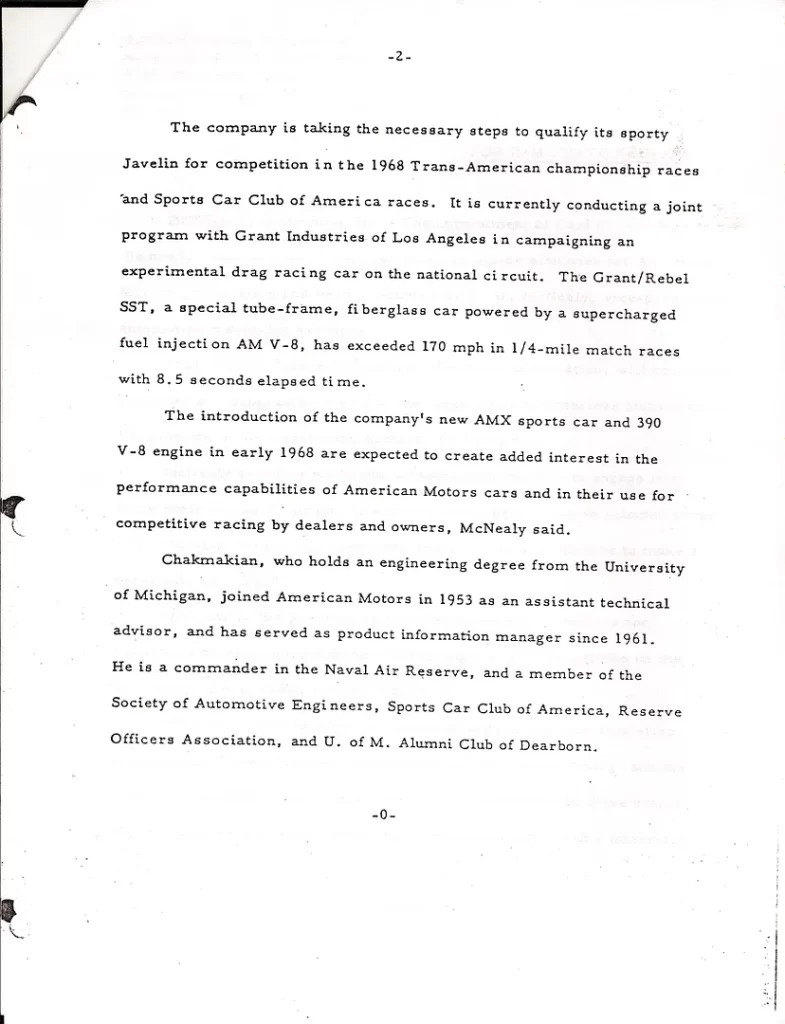
They were gearing up to race the Javelins in the Trans Am racing series in 68, and felt someone in charge of performance would be an asset to the company. Carl Chakmakian was the man for the job.
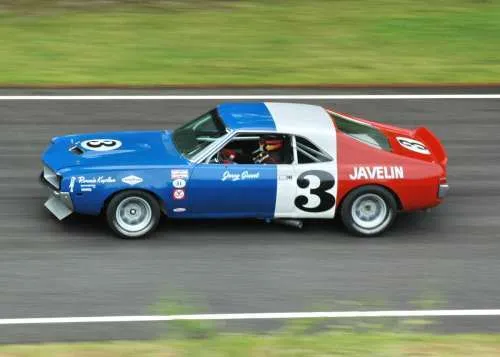
Here are some pictures of the 68 Javelin Trans Am cars and the
Grant Funny Car:

(Before the corporate red, white, and blue paint scheme)


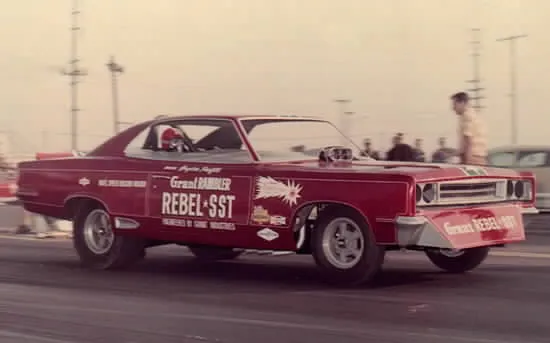

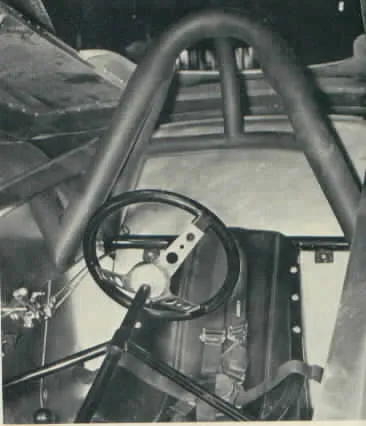
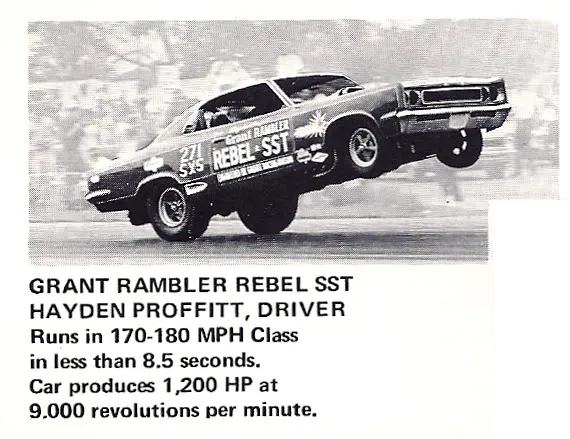

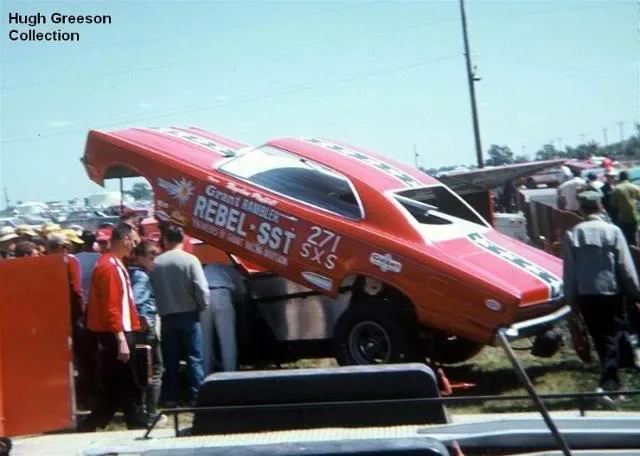
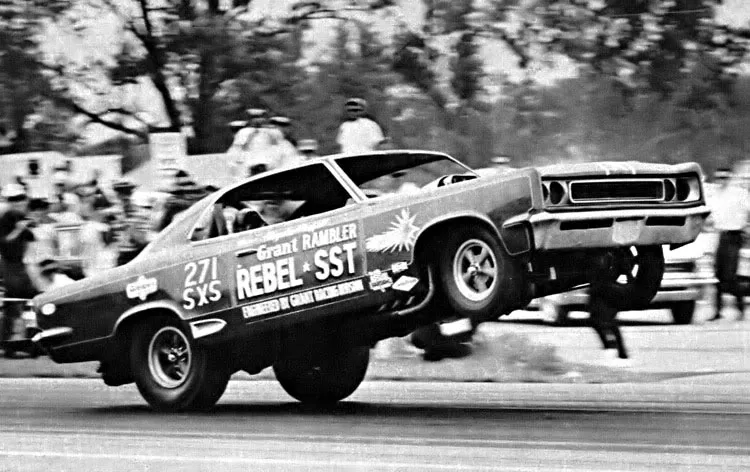
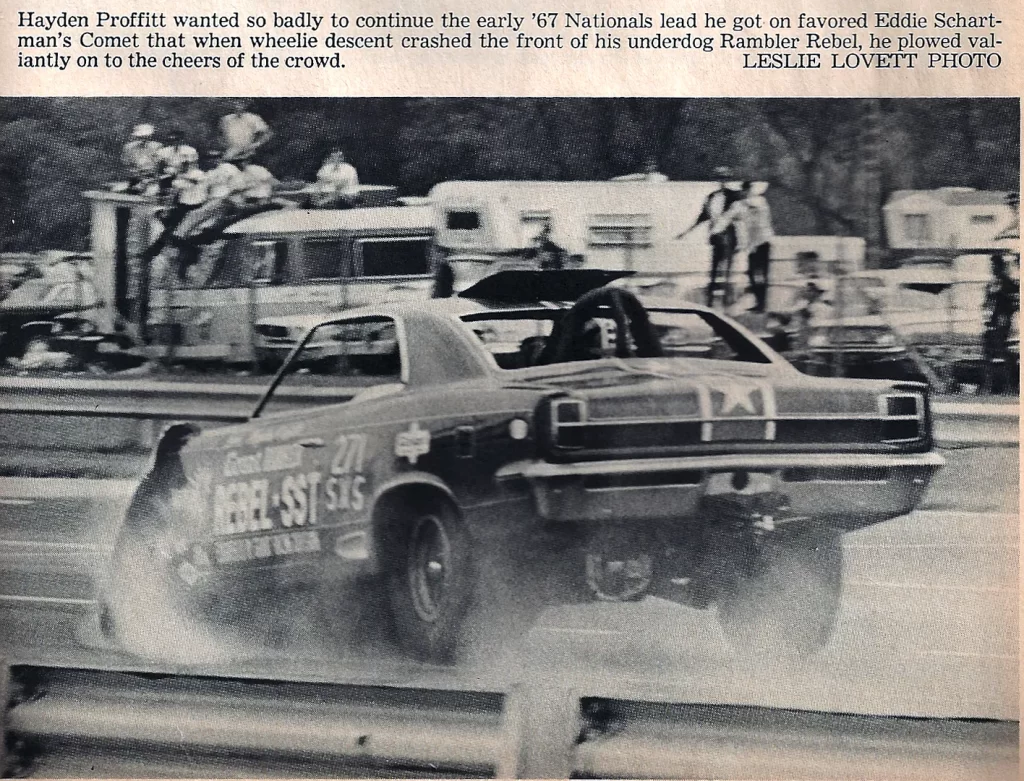

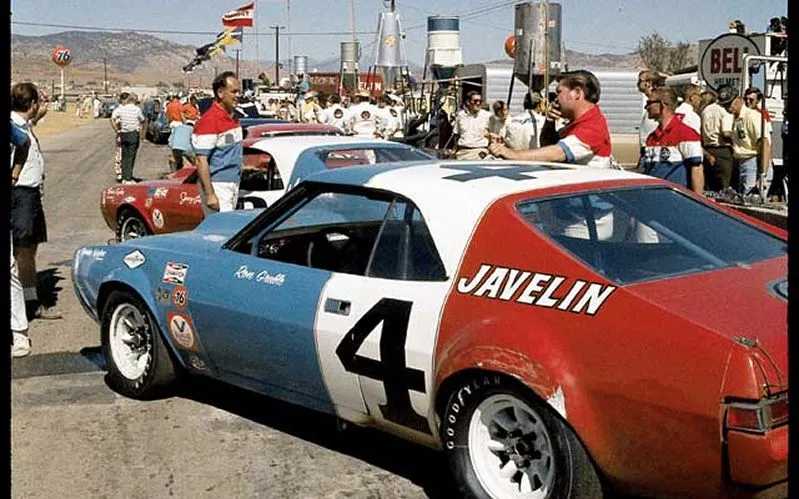
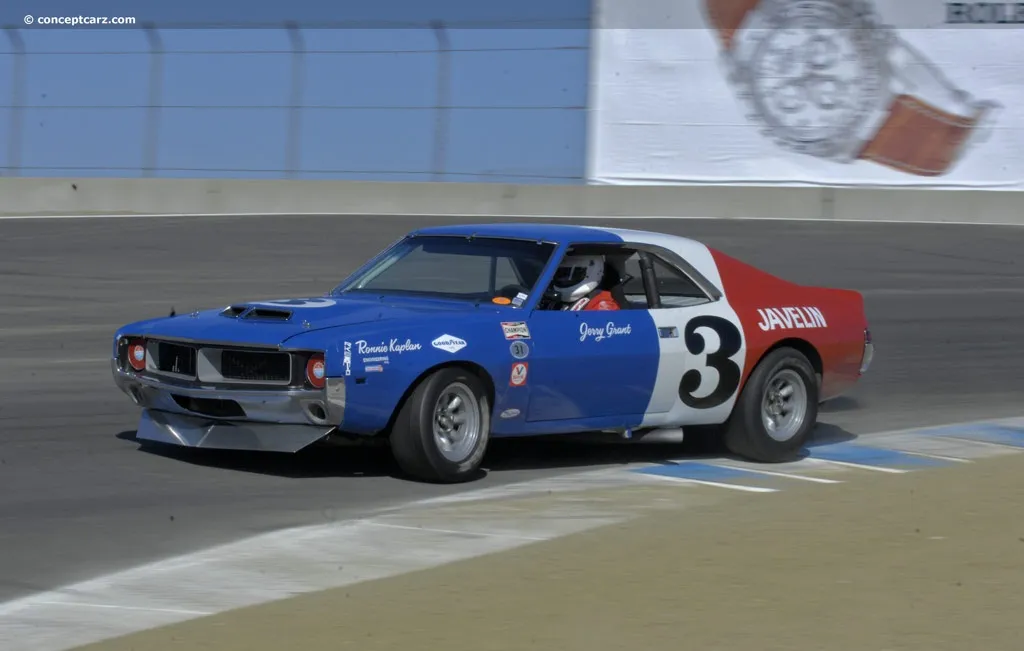
AMC also ran an ad about their racing program, and promising more to come:
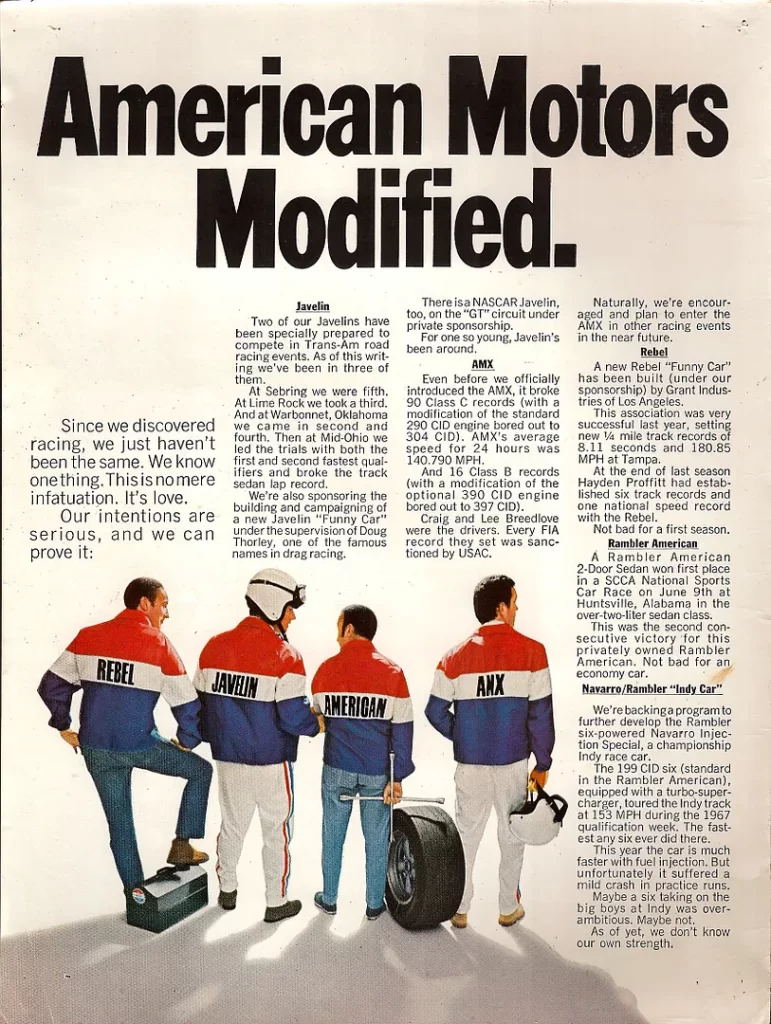
AMC was into racing! A prototype Super Stock car was made from a stock 1969 AMX to be used for testing in late 1968. It was painted the soon-to-be traditional red, white, and blue. A number of hood scoop designs were used, and one was selected to begin trials. Through some trial and error, a final product was tested and presented to the AMC brass. They were more than impressed, and gave the go-ahead to begin production. The NHRA deemed 50 cars were needed for homologation purposes, so 50 were to be built.
So what is homologation? Here is a definition:
“In motorsports, Homologation refers to the approval process a vehicle must go through to race in a given league or series. The regulations and rules that must be met are generally set by the series’ sanctioning body. The word is derived from the Latin homologare for “agree”.”
“In racing series that are “production-based,” (that is, the vehicles entered in the series are based on production vehicles for sale to the public), homologation entails not only compliance with a racing series technical guidelines (for example, engine displacement, chassis construction, suspension design and such) but it often includes minimum levels of sales to ensure that vehicles are not designed and produced solely for racing in that series. Since such vehicles are primarily intended for the race track, use on public roadways is generally a secondary design consideration, except as required to meet government regulations.”
So a minimum was needed to build a car for use on the track. The NHRA declared 50, but other sanctioning bodies were not the same. It is said 100 Trans Am Javelins were built in 1970 for homologation purposes. What were they homologating? This car had a tri-color paint scheme with dealer available spoilers front and rear. I’ve always heard 100 for homologation reasons, but never was able to document this.
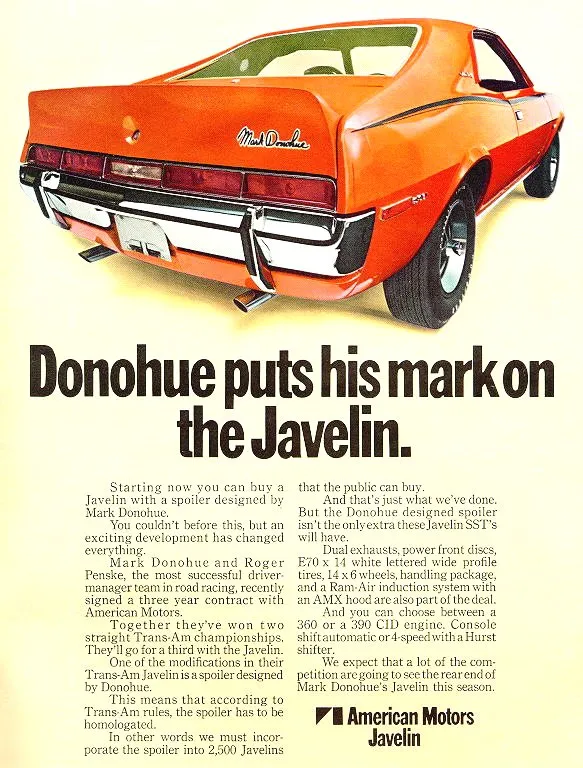
This is called “hearsay evidence” until it can be supported. There is support that at the beginning of the 1970 SCCA Trans Am racing season the homologation standards changed. Now a percentage of the previous years’ production must be made to homologate a car or part. For 1970, AMC came out with the Mark Donohue Javelin.
It had a special spoiler, and a percentage of the previous years Javelin production had to be made to allow AMC to use this spoiler on the race car. The total needed was 2501 Mark Donohue Javelins. Now for years the AMC community said they had to make 2500 and “one in case something happened”, etc. If this were true, then there would also have to be 2500 AAR Cudas and TA Challengers. There were not-their production numbers were as follows:
From the web:
“Officially 2,724 AAR ‘Cuda’s with specification (Y05) and 149 with Canadian specs (Y07) were produced at the Hamtramck, MICHIGAN Plant between March 10, 1970 and April 21, 1970.”
“The T/A would only be available for 1970 as Dodge pulled out of Trans Am racing. Only 2,142 T/As were made.”
As you can see, less than 2500. Yet for years, the AMC hobby repeated “2500 plus one extra in case something happened”. (And what would happen? They just had to make the cars-if one was damaged, do you think they would have to start all over?)
And for history, here are the production numbers for the Boss 302 Mustang, Z/28 Camaro, and Trans-Am Firebird, all 1970 SCCA Trans Am race cars:
“Boss 302- Production numbers were 1,628 in 1969 and 7,013 in 1970. Base Price in 1970 was about $3,720.” “The Z/28 option code was introduced in December 1966 for the 1967 model year. This option package wasn’t mentioned in any sales literature, so it was unknown to most buyers. The Z/28 option required power front disc brakes and a Muncie 4-speed manual transmission. The Z/28 featured a 302 cu in (4.9 L) small- block V-8 engine, 3″ crankshaft with 4” bore, an aluminum intake manifold, and a 4-barrel vacuum secondary Holly carburetor of 780CFM. The engine was designed specifically to race in the Trans Am series (which required engines smaller than 305 cu in (5 L) and public availability of the car. Advertised power of this engine was listed at 290 hp (216 kW). This is an under-rated figure. Chevrolet wanted to keep the horsepower rating at less than 1hp per cubic inch, for various reasons (e.g. insurance and racing classes). The factory rating of 290 hp occurred at 5300 rpm, while actual peak for the high- revving 302 was closer to 360 hp (268 kW) (with the single four barrel carb) and 400 hp (298 kW) (with optional dual-four barrel carbs) at 6800-7000 rpm. The Z/28 also came with upgraded suspension, racing stripes on the hood and trunk lid, ‘302’ front fender emblems on the early cars, and ‘Z/28’ emblems in late 68 & 69. It was also possible to combine the Z/28 package with the RS package.
Only 602 Z/28s were sold in 1967. The 1967 and 1968 Z/28s did not have raised cowl induction hoods as was optional on the 1969 Z/28s. The 1967 Z28 received air from an open element air cleaner or from an optional cowl plenum duct attached to the side of the air cleaner that ran to the firewall and got air from the cowl vents. 15-inch rally wheels, were included with Z/28s had while all other 1967-9 Camaros had 14-inch wheels.
The origin of the Z/28 nameplate came from the RPO codes – RPO Z27 was for the Super Sport package, and RPO Z28, at the time, was the code for a Special Performance Package.
67 Production numbers:
RS: 64,842
SS: 34,411
Z28: 602
Total: 220,906
68 Production numbers:
RS: 40,977
SS: 27,884
Z28: 7,199
Total: 235,147
69 Production numbers:
RS: 37,773
SS: 34,932
Z28: 20,302
Total: 243,085
1970- “Z-28 Special Performance Package” featuring a new high- performance LT-1 360 hp (268 kW) 380 lb*ft (520 N*m) of torque 350 cu in (5.7 L) V8
1970 Production Numbers
Z28: 8,733 $572.95″
1970 Mercury Cougar Eliminator production figure = 2,267
1969 Mercury Cougar Eliminator production figure = 2,250
Here are the 69 Production Figures: 1970 numbers:
Javelin-40,675 1/250th=1017 Total made-2501
Mustang-299,824 1/250th=7496 Total made-7013 Boss 302
Cougar-100,085 1/250th=2502 Total made-2267 Eliminator
Camaro-243,085 1/250th=6077 Total made-8733 Z28
Firebird-87,011 1/250th=2175 Total made-3196 Trans Am
Barracuda-31,987 1/250th=800 Total made-2873 AAR Cuda
Challenger-new 1970 1/250th=? Total made-2142 TA Challenger
And while I am on production numbers, here are a few more:
1512 SC/Ramblers were made. Why? Because that is all they sold. (It was a mid-year production car). If they could have sold 3,000, they would have.
There were 784 SC360s made. Why? Because this car was never meant to sell a lot, but to get people into the dealerships. A letter was sent out to dealers stating the timeline for ordering SC360s had ended, and production had ceased on the car.
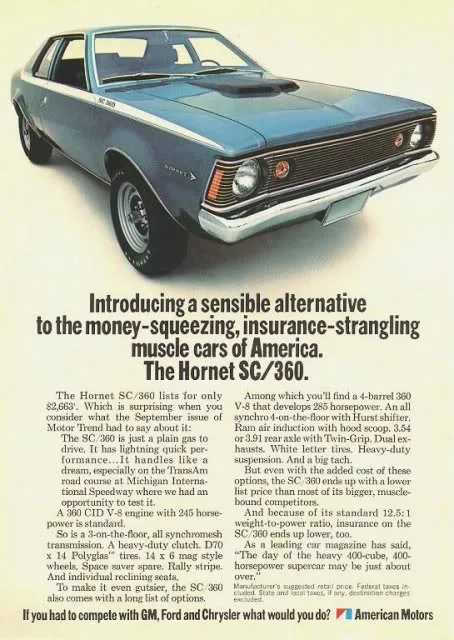
It was never designed to be a big seller. Here are two Primary Source Documents showing just that:
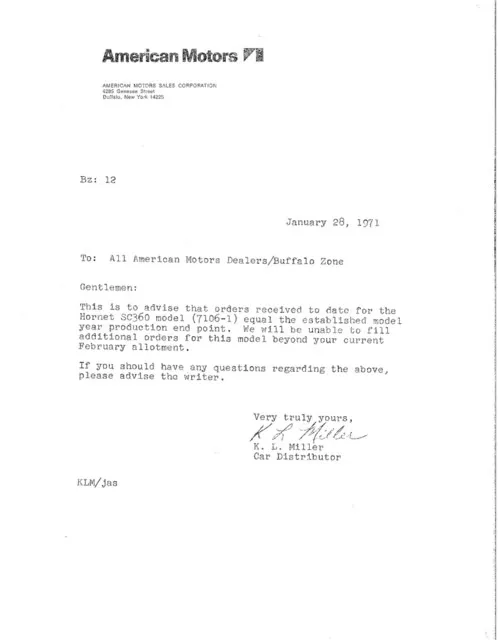
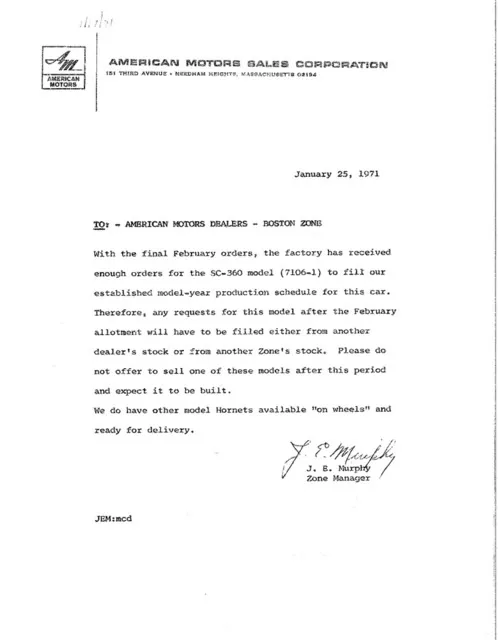
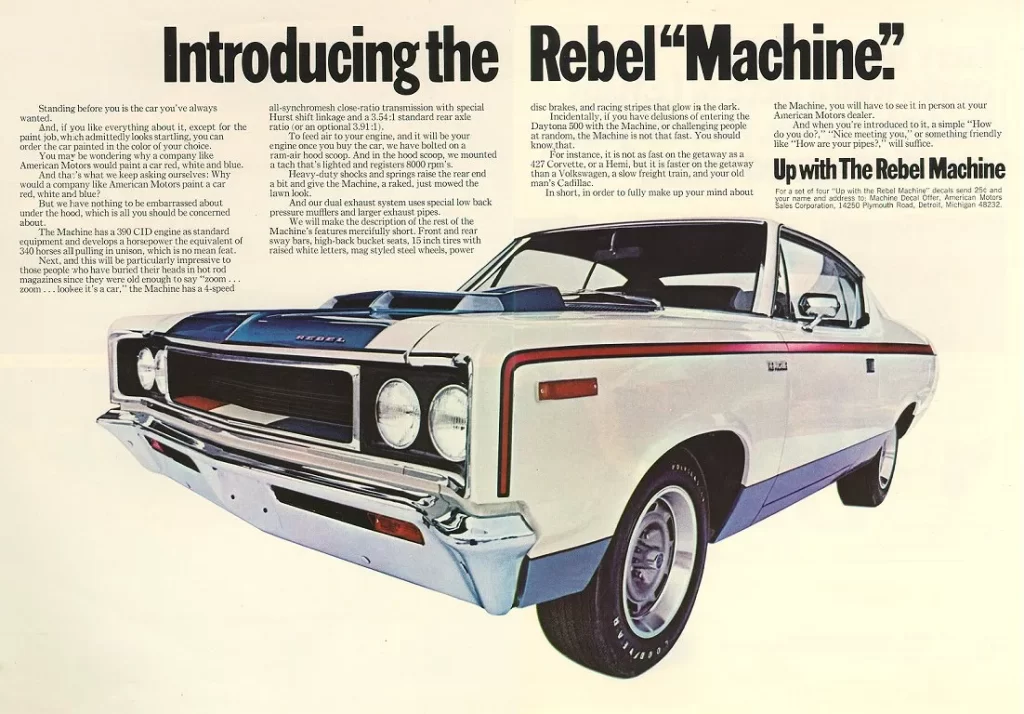
Machines: There were 1936 cars made. Here is the Primary Source document:

Back to the Super Stock cars. It is written all over the place that the NHRA needed 50 built cars to be sanctioned for racing. Here are some examples from other makes: “These 50 special Novas fit into NHRA rules structure, but the stylish though often heavier Camaro remained the weapon of choice for most competitors; with the new transmission, Chevrolet had cars in both SS/C and SS/CA. By the time they arrived (Spring 1968), (Gibb Chevy Nova II)”
“W-30 Olds Smith along with Hurst’s Jack “Doc” Watson sold Oldsmobile management on the idea of building a limited run of special 442s engineered to compete on the drag strip and positively annihilate any musclecar on the street, even the Hemi. A run of at least 50 cars was necessary to homologate this special 442 for NHRA competition and legalize all the parts that comprised the package.”
“Though the ZL1 Camaro was the sleeper’s sleeper, it was never meant for road use. The idea was to homologate these cars for NHRA Super Stock racing. To satisfy the rule, Chevrolet had to build and sell at least 50 of them. La Harpe, Illinois, was the home of Fred Gibb Chevrolet. Gibb requested the first batch via the Central Office Production Order (COPO), the way for dealers to obtain special equipment on Chevrolets so long as the process did not interrupt the normal flow of production cars. In short, if you (Gibb and Harrell) knew the right guys (, et al), you could pretty much get whatever you wanted. In extreme haste, Gibb ordered 51 of the socially unacceptable beasts and the first load was delivered on New Year’s Eve, 1968. A few weeks later, while Gibb and I were looking over the Camaro’s mundane appointments at Harrell’s shop, he told me that he was so excited about the event that he’d left a party early to be at his store when the truck arrived with its historical cargo.”
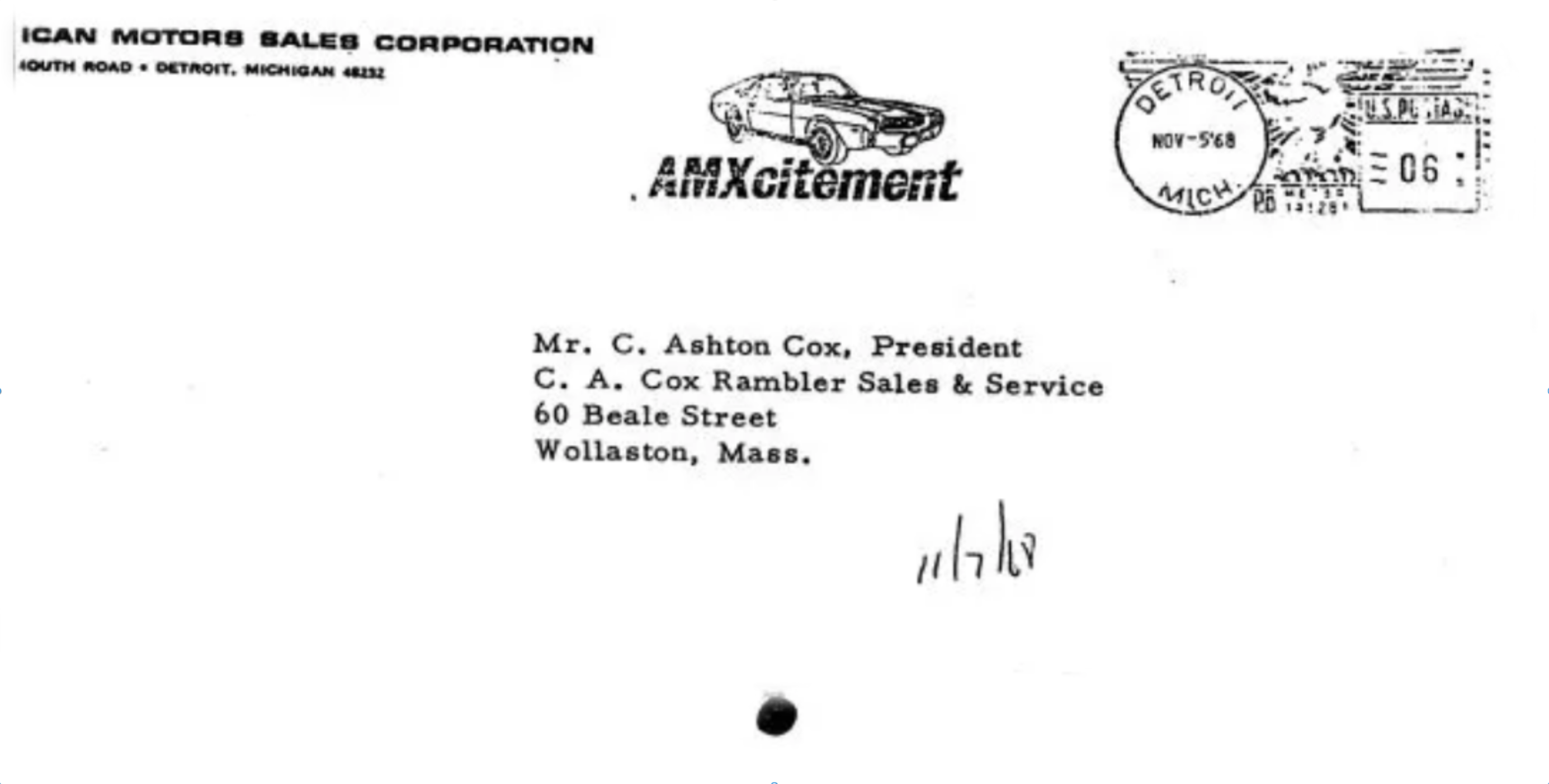
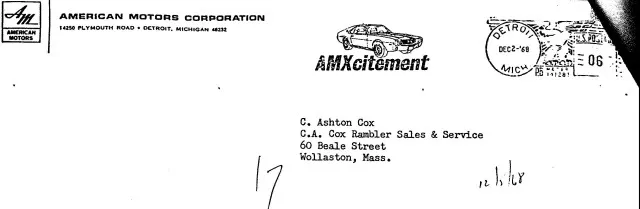
Despite everyone saying 50, the AMC crowd still says “52 plus….here it comes- one in case something happened”. Thus the “52 or 53, depending on the source” you see quoted. (And again, what source?) Even though it may be written all over the ‘net that 50 were needed, where is the Primary Source document that proves this? I haven’t seen one for the other models, but I do have one for the AMX! A letter was sent out to various dealers that had a racing program in place-not every dealer got this letter. It was dated November 4, 1968 and mailed November 5 (and was received at CA Cox Rambler, Wollaston, MA on Nov 7-he dated everything).
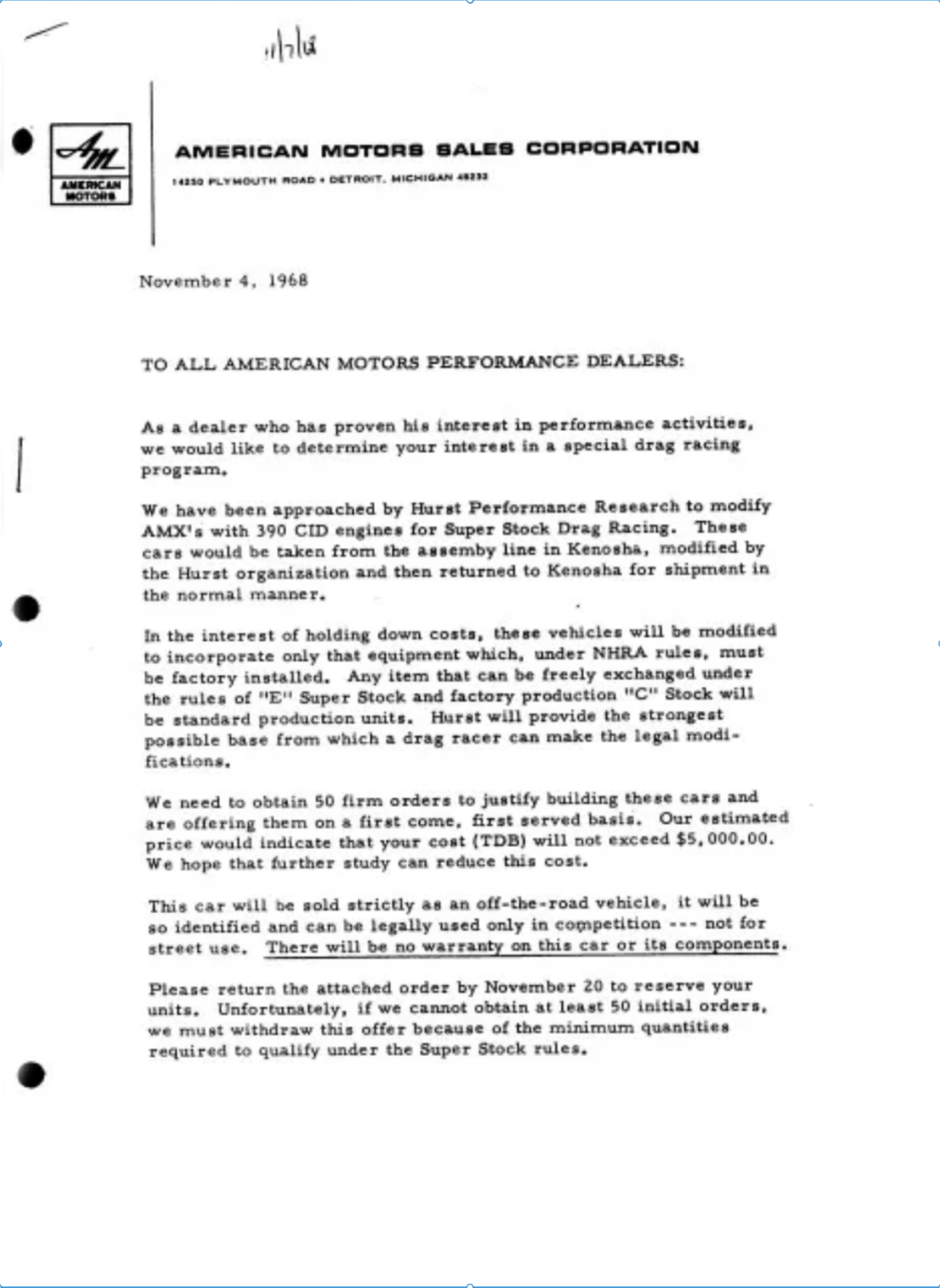
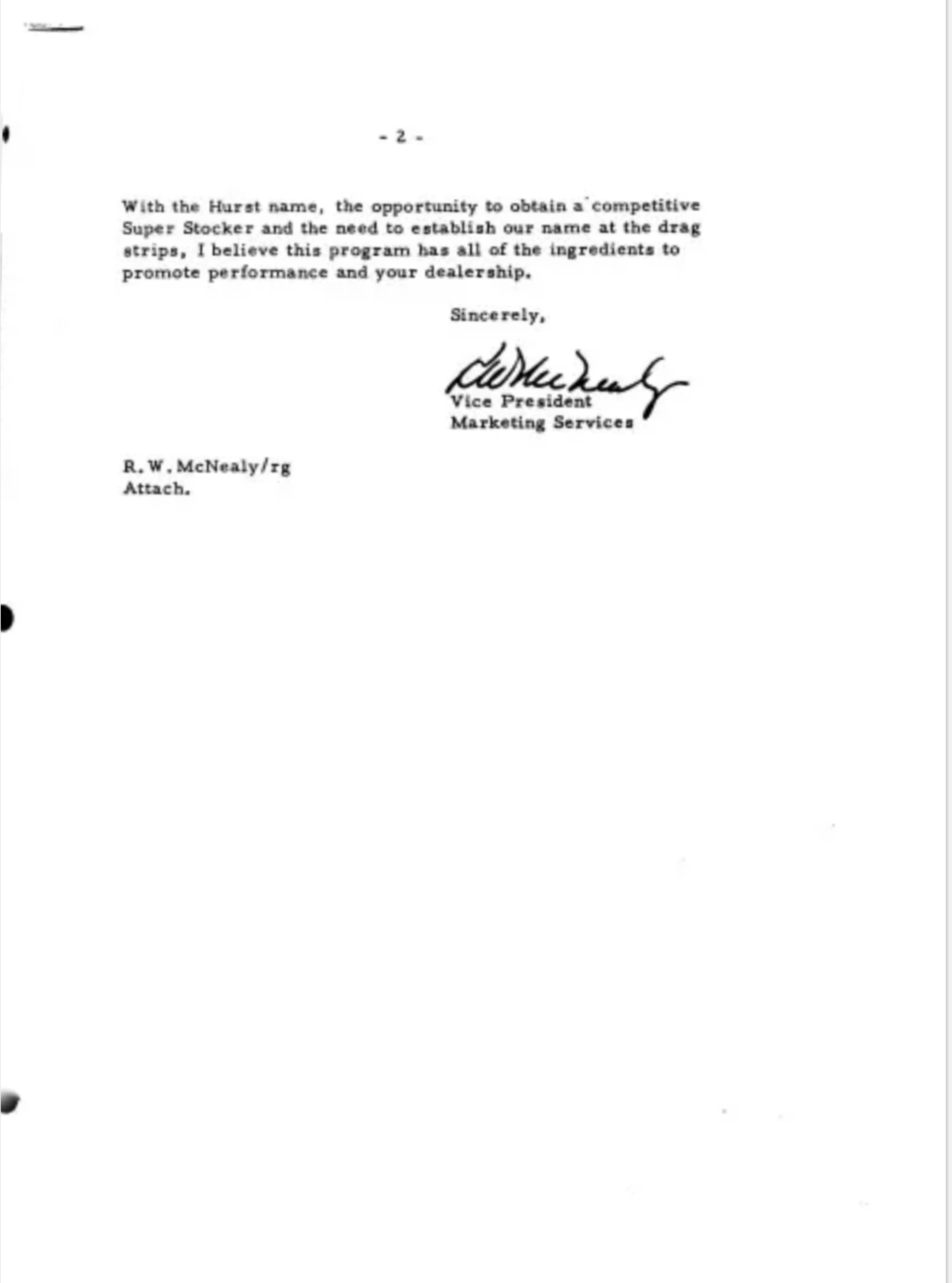
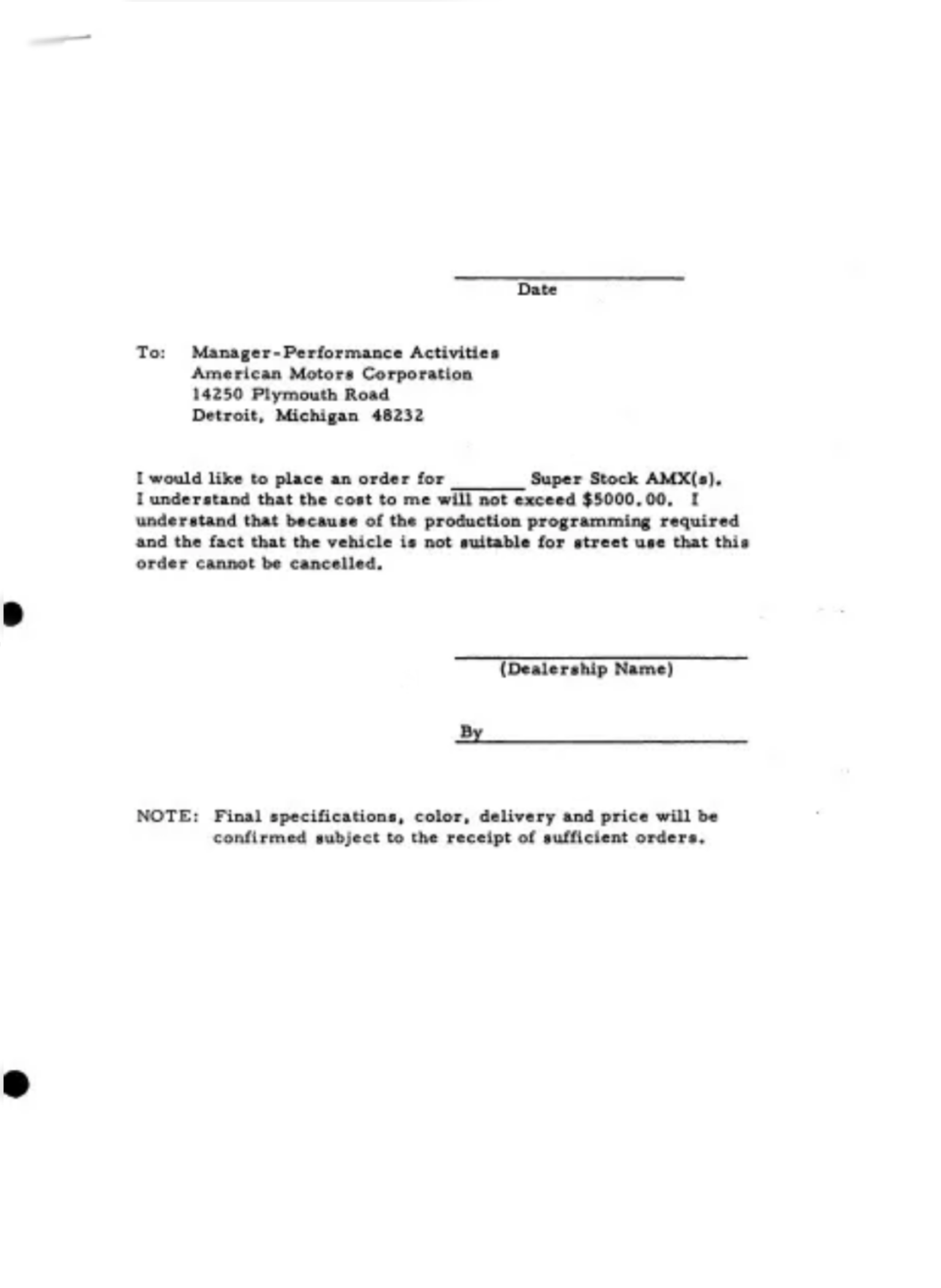
Note the price-not to exceed $5000. This was signed by Bill McNeilly, the VP of Marketing, who had the enviable job of promoting this and other AMC cars.
Here is a copy of the envelope (I told you Cox saved everything, dated it, 3 hole punched it and put it in a binder).
The letter as seen above mainly asked for 50 dealers to step forward to order the car or it would not be made. Price would be about $5000. The deadline to order was November 20, 1968. An order form was attached. AMC was going to build a Super Stock race car! It is very clear they must build FIFTY (50) cars. So why do so many people quote “they had to build 52?” Where did this come from?
Just more AMC speculation that is repeated enough that it becomes the standard.
So, can we all agree AMC only had to build 50 cars?
Let’s look at one other clue from this Primary Source document. Note the date? Somewhat early in the model year. So why do we see “after the success of the SC/Rambler, AMC worked with Hurst to build a race car”. What success? 1512 cars is not really a success. Plus, the SCRambler was introduced to the public at the Chicago Auto Show March 8, 1969 (along with the prototype Super Stock AMX).
The SS/AMX cars were being made at this time, with 50+ confirmed orders. They were released late March and early April.
Therefore, the “success” of the SC/Rambler had nothing to do with the SS/AMX. They were both actually conceived at the same meeting.
Two myths down…….
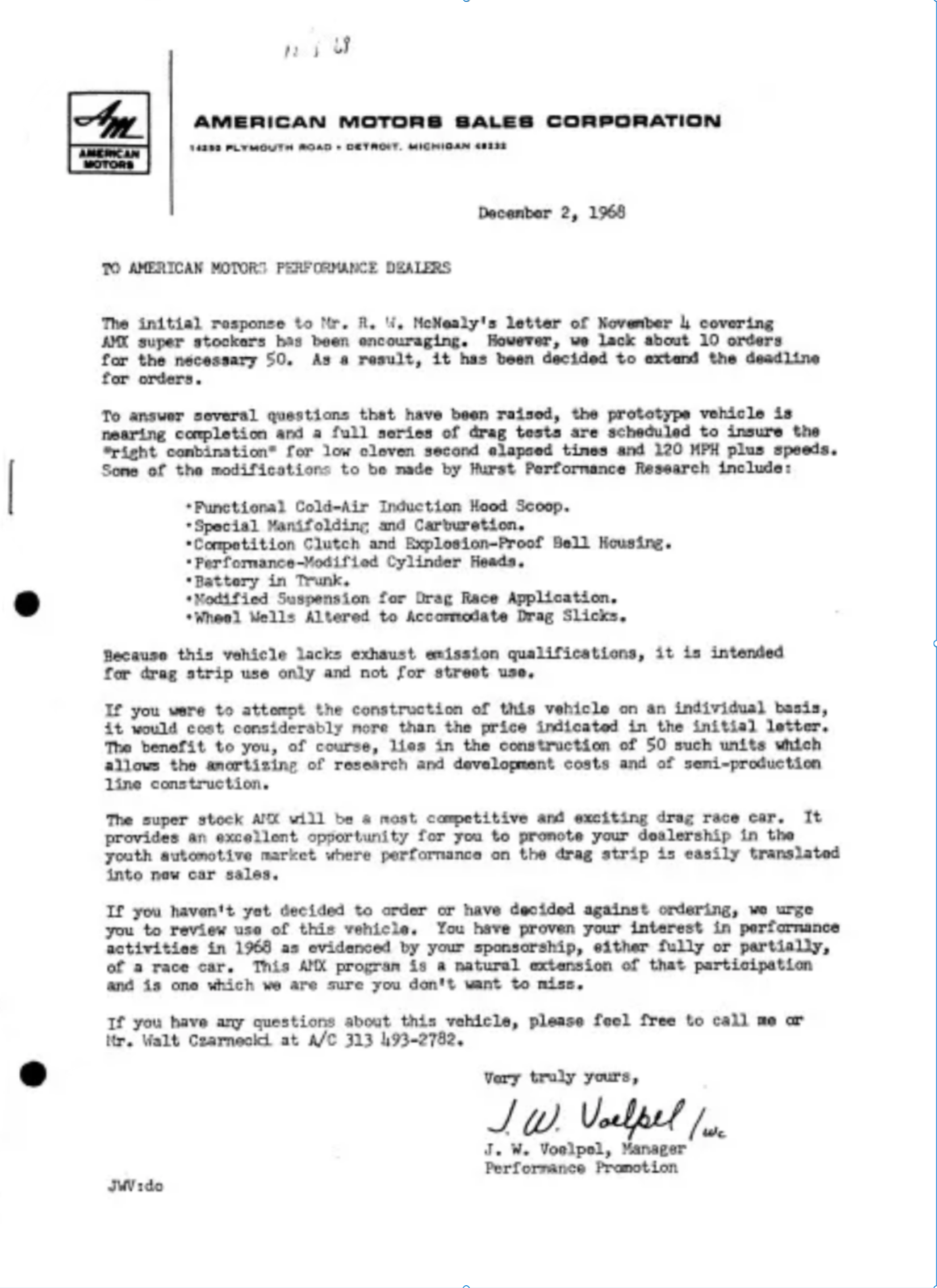
The November 20, 1968 deadline came and went and only 40 cars were ordered. A second letter dated December 2, 1968 was sent to the dealers again (Mailed Dec 2, 1968 and received Dec 5, 1968).
This letter stated the dealership was contacted as they had sponsored a race car the previous year. It went on to say what was going to be done to the car:
Hood scoop and induction
Special manifold and carbs
Clutch and bellhousing
Modified cylinder heads
Relocated battery
Modified suspension
Altered wheelwells
It also stated it was not for street use, did not pass emissions, and had no warranty.
Nothing about tires and wheels, paint, pistons, etc. etc.
And get this:
“the prototype vehicle is nearing completion”. This was December 2, 1968!
So here is an admission from AMC on a Primary Source document that states a Hurst SS/AMX was made that is not in the sequence commonly accepted. Call it prototype or whatever, it is a Hurst-made SS/AMX, but this car surely does NOT fit into the VIN sequence we have all seen and acknowledged as “the only ones made”.
Another myth down (and FYI-the whereabouts of this car is known- Howard Maseles raced it for Hurst, then Jack Thomas and then it was sold to Garrett Ghezzi, who still owns it and races it competitively.) (See “Prototype” page for more info and pictures.)
Here is a copy of the Dec 2 letter:
So, you now see why I questioned the production numbers of these cars.
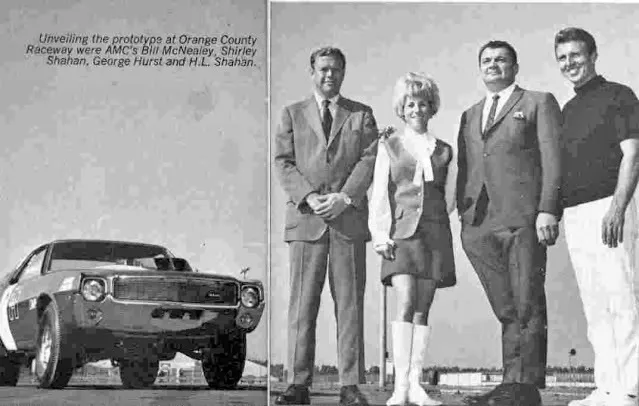
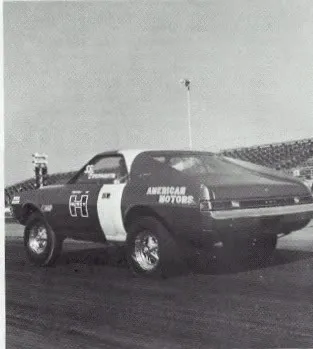
Here are some pictures of the original prototype AMX (note the scoop). The car was sent to Miami FL for development, then on to Orange County Raceway to introduce it to Corporate AMC and the Press. It was also a time to introduce HL and Shirley Shahan, who were signed by the Southern California AMC dealers to race an SS/AMX on their behalf. (HL did a lot of prep work on this car before the release to the press, a lot of it at the Hurst facility).
(Another myth-she was signed by Corporate AMC, but she raced for the Southern California Dealers Association. AMC retained ownership of the car she raced and it had to be returned when the Shahans were done with it. See “car #35” for more info.).
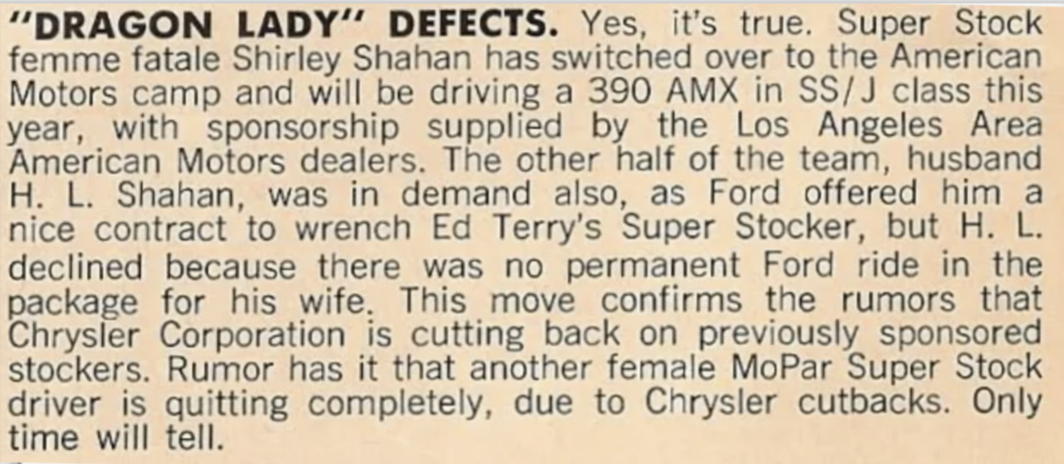
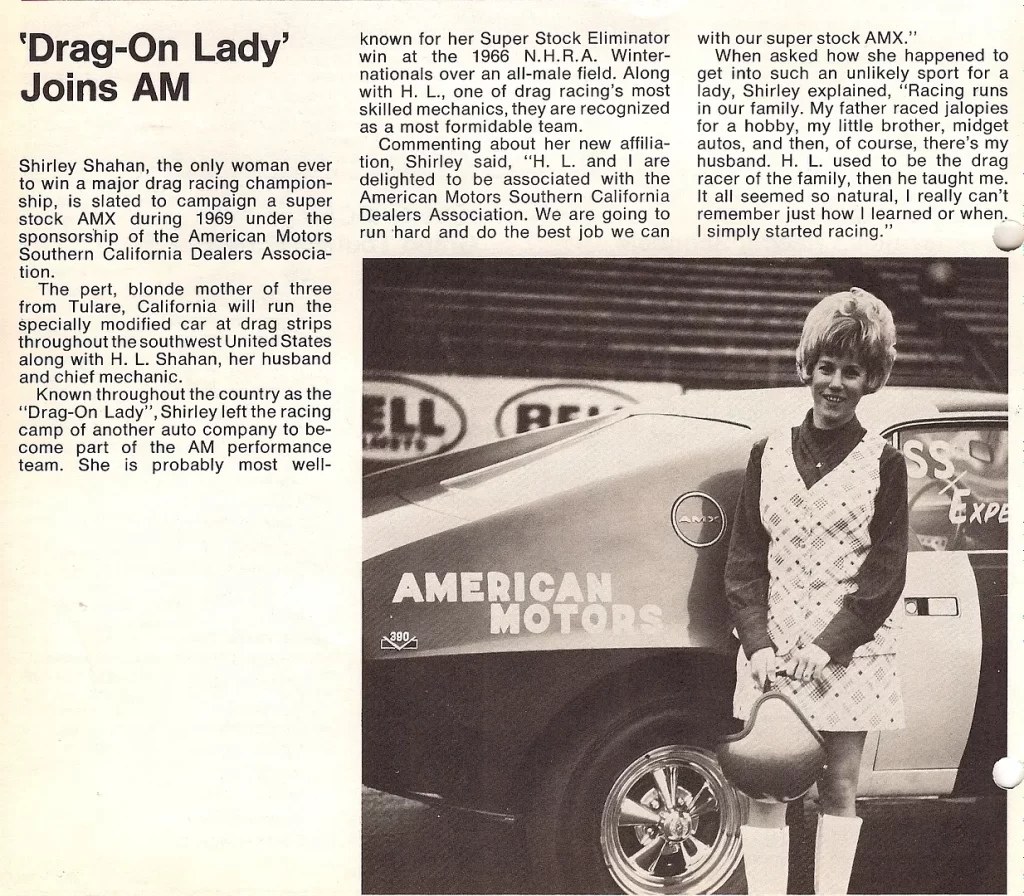
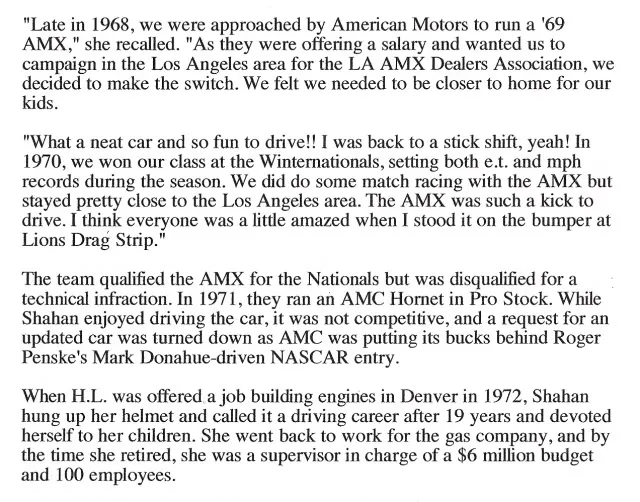
And here is an interview (I do not know the author):
Here she is with Bill McNealey of AMC, and her husband H.L. This was mid-February 1969 at Orange County International Raceway, Calif.
This is one of the test runs down the track for the Press.
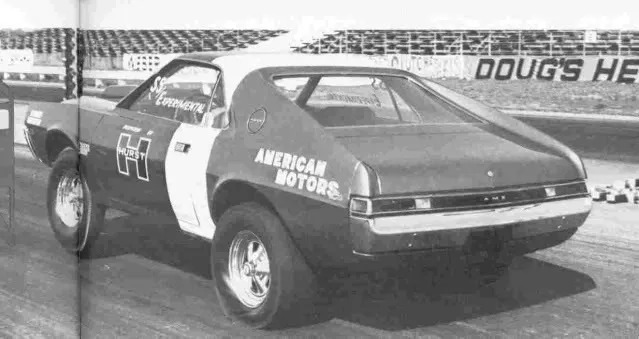
I have to wonder about this scoop, but then again, they did design the Hurst Olds scoop and the SCRambler scoop. Because the scoop was fiberglass and not metal the NHRA did not allow it, thus a new one was made by the same company that made the Hurst Olds scoop.
Here she is inside the car. Note back of scoop, heater controls (remember, it was a prototype. No big deal). Headrests have been removed. And is that a clock knob?
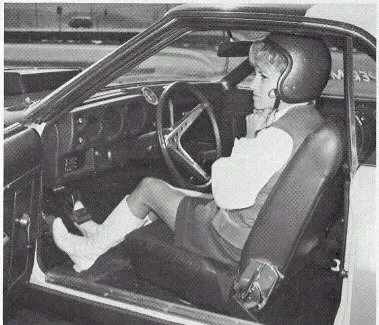
And again. Carpet is obviously cut, no radio pod, tach in the center pad, the car had headrests but they have been removed. Waffle style headliner. And a block of wood on the clutch pedal!
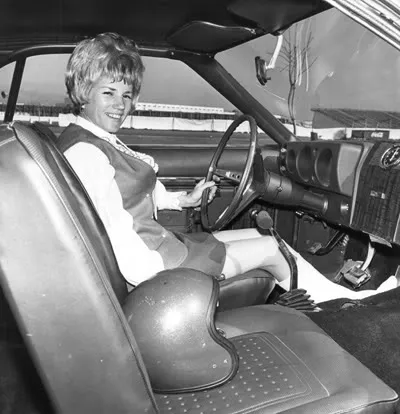
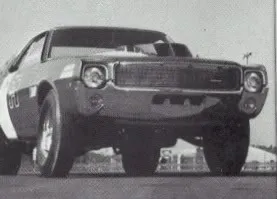
Definitely a white car. Still has hood hinges, missing core support bars, filler in front of radiator, (Piece attached under the hood did not see production).
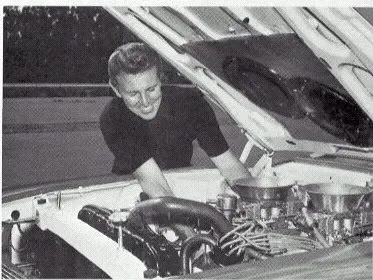
(Some of these pics came from a Car Craft article).
By the end of March all was a go, and the cars were being produced.
Here is a press release from that time:

Also involved with this project was David Landrith, who had just signed on with Hurst and would leave in 1971 to start his own racing consulting firm-one of his first customers were the Shahans and their Hornet and Gremlin Super Stock cars.
Here is a scan of Dave:
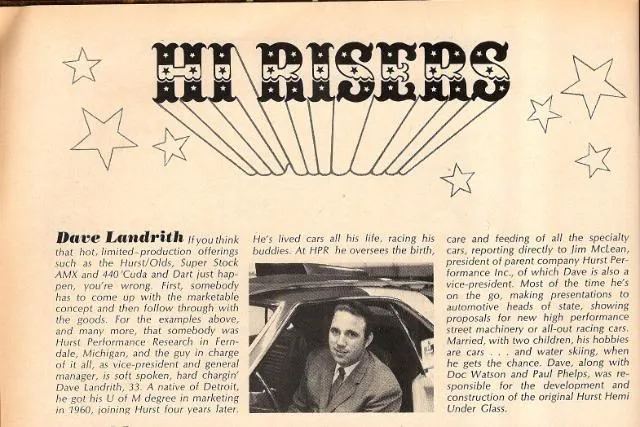
Though it may look like this SS/AMX he is sitting in has leather seats, further study with a better computer application just shows it to be the “dots” in the 69 upholstery.
And Dave was not the only one to come from Hurst:
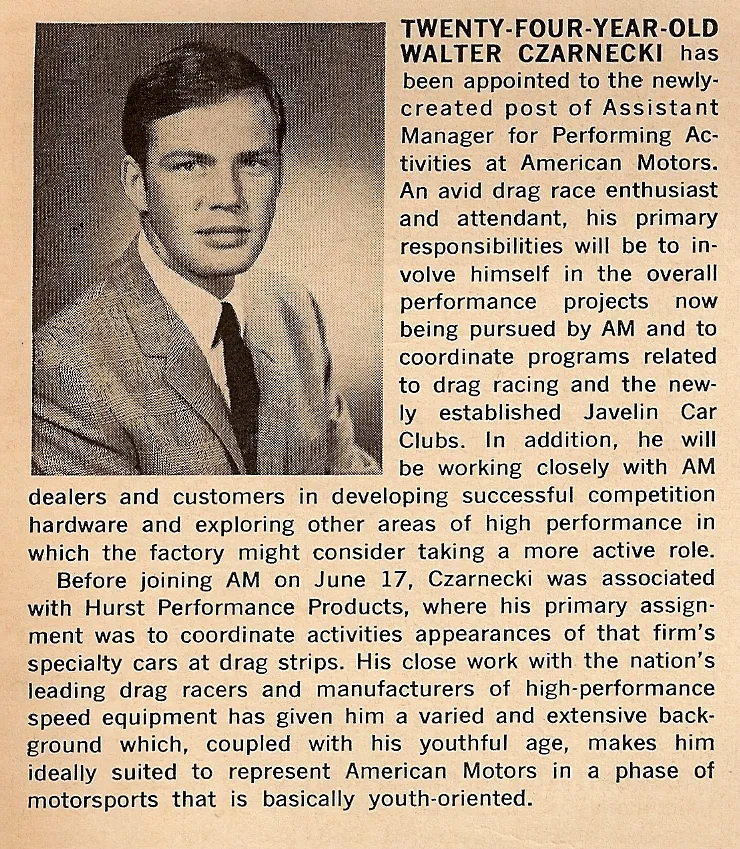
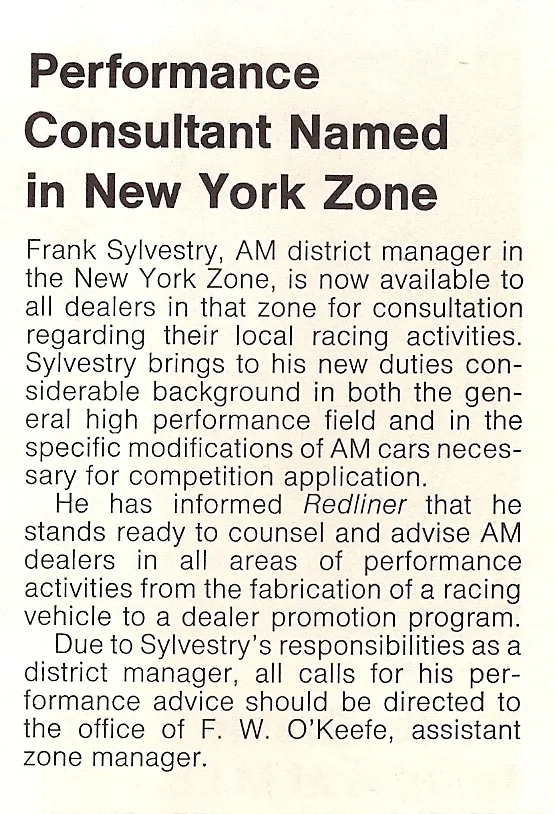
The New York Zone also had a Performance Specialist (I wonder if all the zones had one):
The final list of owners was sent out to the NHRA on May 5, 1969: